

























































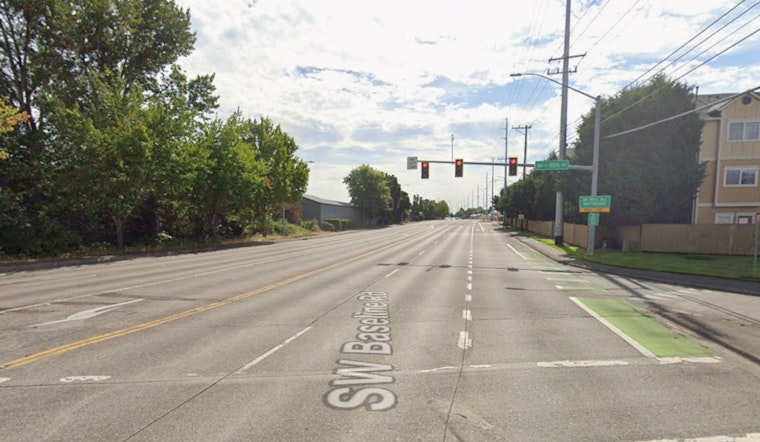
Anyone who drives Southwest 185th Avenue at Baseline Road already knows the drill: the gates drop, the MAX rolls through, and traffic stacks up in every direction. The at-grade MAX crossing cuts straight across one of the region’s fastest-growing neighborhoods, and city officials say it now handles roughly 30,000 vehicles a day, while trains can lock the crossing dozens of times during peak hours. Hillsboro is trying to juggle a long-term plan for a grade-separated MAX overcrossing with a near-term “Smart 185” signal upgrade, and the sticking point is money.
How bad is the bottleneck?
According to a memo prepared for the city’s Transportation Committee, the corridor carries about 30,000 vehicles each day, and train frequencies have increased since 2024 service changes, which has meant more gate closures and more signal pre-emption. Staff say that combination is producing long, sustained queues that slow buses and delay people walking and biking. As detailed in the Transportation Committee agenda, the at-grade crossing was originally designed for far lower train and vehicle volumes than it is seeing now.
AI signals as a stopgap
To buy some time, city engineers are pitching Smart 185, an AI-driven traffic signal and rail coordination system that would rely on radars, cameras and detectors to time nearby signals around approaching MAX trains and give buses priority through the intersection. The City of Hillsboro describes the upgrade as a way to “extend the useful life” of the existing at-grade crossing until a permanent overcrossing can be funded and built. Earlier coverage has outlined the project scope and the community outreach behind Smart 185 that helped shape the concept.
Funding fight
Even with broad local support, staff records show both the permanent overcrossing proposal and earlier Smart 185 grant applications came up short in previous rounds of Metro regional funding. Project exhibits put Smart 185’s estimated cost at about $1,899,919, and while partners have secured federal ATTAIN dollars and ODOT grants, that package still leaves a multi-million-dollar hole. As documented in the Transportation Committee memo, those prior Metro applications did not make the cut, and staff are now working to pull together remaining local matches and letters of support.
What’s next for the crossing
City staff told KATU they plan to take another run at Metro funding while also chasing other federal and local contributions. Gregg Snyder, Hillsboro’s transportation systems planner, underscored how close the city is on Smart 185’s finances, telling KATU, “We only need $1.4 million,” since much of the technical work is already funded. Officials say closing that final gap would clear the way for Smart 185 to move into procurement and construction, even as partners keep pushing for a longer-term grade separation.
Longer-term fix still a bridge
City materials are clear that the permanent solution is a grade-separated MAX overcrossing, a much bigger and more complex project that will require significantly more money and tight interagency coordination. Hillsboro has targeted regional and federal funding programs in the 2028-2030 cycle and is continuing to build local matches and letters of support while Smart 185 chases the last dollars needed to trim today’s delays. City of Hillsboro outlines the timeline and explains how the two approaches, technology now and structure later, are meant to work together.





