

























































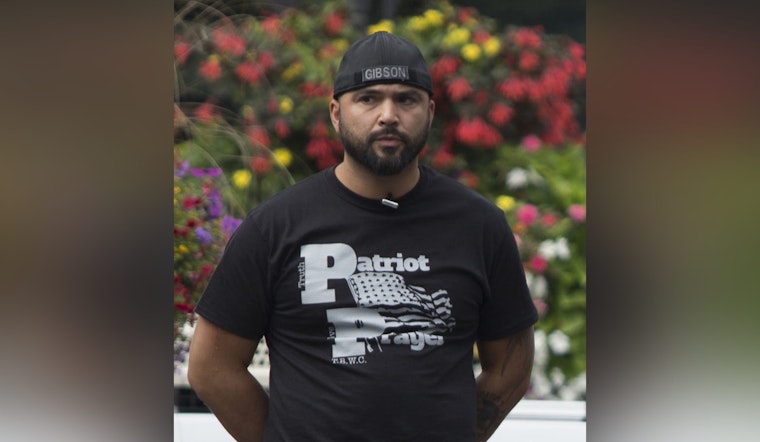
A sliver of Patriot Prayer founder Joey Gibson's long-running legal fight is back on. A federal appeals court on Thursday revived a narrow part of a civil-rights lawsuit Gibson and supporter Russell Schultz filed against Multnomah County prosecutors, allowing a single focused claim to move forward while leaving most of their case on the cutting-room floor.
The U.S. Court of Appeals for the Ninth Circuit ruled that Deputy District Attorney Brad Kalbaugh can be sued in his personal capacity over a probable-cause affidavit he signed, which included language such as “I have probable cause to believe.” The panel said that if the plaintiffs can show that the affidavit functioned as a false sworn statement, it could fall outside the shield of absolute prosecutorial immunity. At the same time, the court kept in place protections for the Multnomah County District Attorney's Office and most other officials, finding they are barred from money-damages claims by the Eleventh Amendment. The majority, written by Judge Jay S. Bybee, knocked the original complaint as a “shotgun pleading” but gave Gibson and Schultz one more shot with a tightly tailored filing. Judge Danielle J. Forrest agreed with sending the narrow claim back but wrote separately to warn against adopting a broad shotgun-pleading rule. The limited revival was first reported by The Oregonian/OregonLive.
What the Appeals Panel Actually Did
The appeal, filed under case number 24-1663, grew out of a federal lawsuit lodged last year that accused Multnomah County authorities of targeting Gibson and Schultz for political reasons. According to Justia Dockets & Filings, the pair initially sued the City of Portland, Multnomah County, the Multnomah County District Attorney's Office, the Portland Police Bureau, and several named officials. Trial judges had already trimmed that wide-ranging case down, relying on immunity doctrines and jurisdictional limits.
On appeal, the Ninth Circuit did not bring the whole lawsuit back from the dead. Instead, it sent only the specific “false-affidavit” theory back to the trial court for another look, while leaving in place the rulings that block most official-capacity claims for money damages.
Backstory: Cider Riot and the 2019 Street Clash
The dispute traces to a chaotic confrontation on May 1, 2019, outside the now-closed Cider Riot taproom in Northeast Portland. Members of Patriot Prayer and counterprotesters squared off in the street, an incident that became one more flashpoint in Portland's protest politics.
Gibson and Schultz were eventually prosecuted in Multnomah County on a riot charge. In 2022, a judge acquitted them after finding there was not enough evidence to convict. Local reporting on the trial and its video evidence is detailed by OPB. The later federal civil-rights suit, which challenged how that prosecution unfolded, largely stalled out on procedural grounds before the Ninth Circuit stepped in to salvage the narrow affidavit-based claim.
Legal Stakes: Immunity, Motive, and One Contested Affidavit
The decision zeroes in on a familiar legal tension. Prosecutors enjoy sweeping absolute immunity for charging decisions, the panel stressed, and that protection applies “regardless of motive.” In other words, even if a prosecutor is accused of being politically driven, the act of deciding to bring charges generally cannot be the basis for a damages lawsuit.
The court drew a line, however, at allegations that a prosecutor personally swore to an affidavit that contained deliberate falsehoods. When a prosecutor signs an affidavit framed as an attestation of probable cause, the Ninth Circuit noted, that document can carry special legal weight. If that sworn statement is shown to be knowingly false, it may be treated differently from routine charging decisions.
In this case, the panel said Gibson and Schultz may pursue that narrow theory against Kalbaugh in his personal capacity while other damages claims remain dismissed. The outlines of the decision and the case's procedural history appear in earlier filings available through Justia. U.S. District Judge Karin J. Immergut had previously thrown out an earlier federal challenge under abstention and related doctrines, leaving some state-court remedies on the table.
With the Ninth Circuit's latest move, the lawsuit heads back to federal court in a much smaller, more technical form. Gibson and Schultz now have a chance to rewrite their complaint around the alleged false affidavit and seek damages from Kalbaugh personally. Whether Multnomah County officials will ask for further review, and how the district court will handle any new filing, remains to be seen. For now, the ruling is a reminder that in politically charged prosecutions, the fine print in an affidavit can decide whether a case gets aired in federal court at all.





