

























































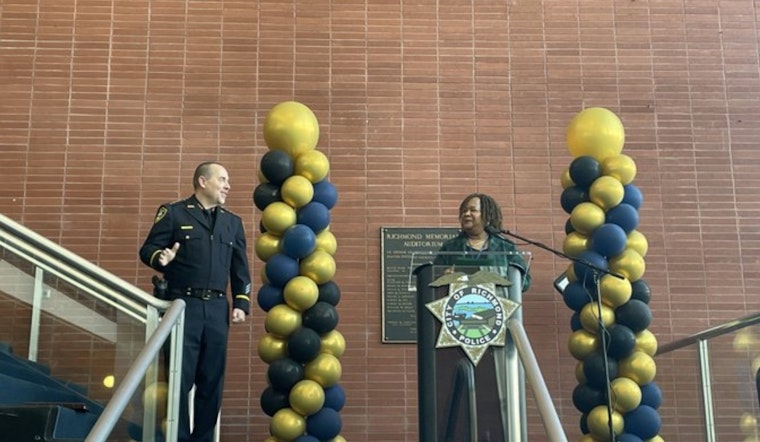
Richmond is handing the keys to its police department to someone who knows the streets and the corner coffee shops. Timothy "Tim" Simmons, a 17-year veteran of the Richmond Police Department, has stepped into the chief's job at a moment when the city is still digging out from staffing shortages and a late-2025 spike in shootings.
Simmons is signaling that he wants to bring the department back to basics: neighborhood-focused policing, familiar faces on the beat, and a closer eye on how police technology is used. One of his first major moves was to hit pause on the city's automated license-plate reader system while the department scrutinizes its data safeguards, a decision that has residents and community leaders watching closely to see if his early promises turn into more officers and calmer nights.
Richmond City Manager Shasa Curl announced Simmons' selection in December, and the city says he officially took over in mid-January, according to the City of Richmond. City officials also marked the moment with a short welcome message on the City of Richmond's social media post, introducing residents to the department's new top cop.
The City of Richmond is proud to welcome our new Chief of Police, Tim Simmons!#PoliceChief #richmondpolicedepartment #TimSimmons #RichmonCA #RichmondCalifornia pic.twitter.com/GLZXI8zCDn
— Richmond, CA (@CA_Richmond) January 30, 2026
Background and the City's Announcement
"I am honored to serve as Chief of Police for the Richmond Police Department," Simmons said in the city's announcement, where officials highlighted what they described as his long-running focus on community-centered policing and transparency, the City of Richmond reported. Over 17 years with the department, Simmons worked his way up from beat officer to assistant chief before landing in the corner office.
City leaders have framed his promotion as a homegrown choice, one meant to reassure residents that the person setting policy has walked the same streets officers are being asked to reclaim.
Chief's Priorities: Staffing and Neighborhood Policing
At neighborhood meetings, Simmons has wasted little time spelling out his top priority: bodies in uniforms. He has been blunt that Richmond simply needs more officers if it wants real community policing, not just a slogan on a brochure.
The Richmond Standard reports that Simmons aims to fill roughly 22 open positions and reach about 55 patrol officers by June. Hitting that mark, he has said, would free up specialty units that have been sidelined by staffing gaps and allow them to be redeployed across the city where they are most needed. As part of that push, he has already sworn in several lateral officers who are jumping over from other departments.
Simmons has also stressed a return to old-school beat policing, telling residents he wants them to see the same officers regularly, not a rotating cast of unfamiliar faces rolling through in patrol cars.
ALPR Shutdown and Privacy Questions
On the technology front, Simmons' first headline-making move came when he shut down the department's Flock automated license-plate readers after learning that an administrative setting had allowed Richmond's ALPR data to be searchable by outside agencies, Richmondside reported.
"The moment I found out about this issue, I shut it off completely," Simmons told the outlet. Officials say the cameras will stay offline until the department can confirm that stronger safeguards are in place and that access to the system is properly locked down.
Richmondside also noted that in one recent 30-day period, the city's ALPR portal logged more than 431,000 license-plate reads, a reminder of just how much information the system quietly collects. The department says it has found no evidence so far that outside agencies misused Richmond's data, but the scope of the system has added urgency to the ongoing review.
Crime Trends and the Challenge Ahead
Statistics gave Richmond a partial victory in 2025, with the city recording one of its lowest homicide totals in recent memory. The story on gunfire, though, was more complicated.
Simmons told the Community Police Review Commission that there were about 50 shooting incidents in the final 90 days of 2025, a late-year burst that undercut the good news on homicides. In response, he has ordered targeted deployments to hotspots, including the Iron Triangle and Richmond Annex, according to the Richmond Standard.
The chief has said publicly that rebuilding trust will require more than just numbers on a CompStat report. In his view, it will take additional officers on the street paired with sustained outreach so residents feel comfortable calling the police long before a situation turns into the next statistic.
Community Reaction and Next Steps
So far, reaction from City Hall and neighborhood leaders has been cautiously optimistic, with a clear side of we will be watching, Richmondside reports.
Councilmember Sue Wilson called the immediate shutdown of the ALPR system a really big deal, framing it as a sign that Simmons is willing to pull the plug on powerful tools if their guardrails are shaky. Councilmember Claudia Jimenez has likewise praised him for consistently talking about both safety and transparency when he explains his decisions to the public.
Simmons, for his part, has invited neighborhood leaders to stay closely involved as the department weighs its options on technology, staffing, and local partnerships, signaling that he expects them to hold him accountable as he reshapes the force.
What's Next
In the near term, residents can expect to see Simmons back in front of the City Council early next month with proposed fixes for the ALPR system and a clearer roadmap for how it might be brought back online. At the same time, his recruiting push for both lateral hires and new officers is set to continue as he tries to rebuild patrol ranks to the levels he says are needed for real community policing.
Richmond's city manager and other officials have said they will be tracking his tenure by looking at three basic yardsticks: how many officers the department hires, what happens to crime trends, and whether relationships with neighborhoods show real improvement, according to coverage by SFGATE.





