

























































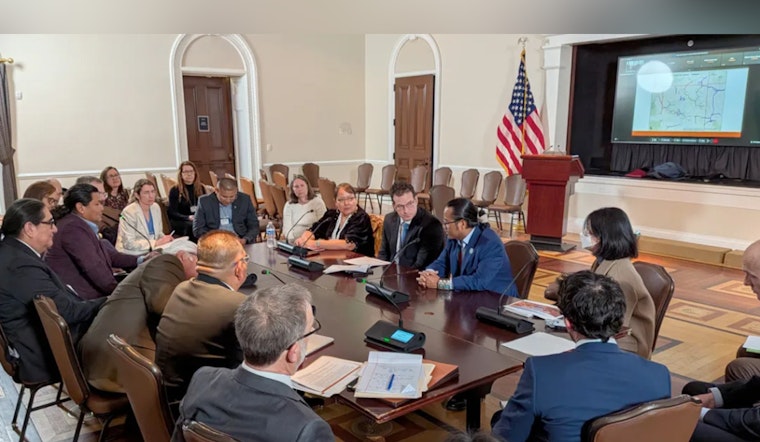
Arizona tribal leaders traveled to Washington, D.C., this week to urge Congress to pass the Northeastern Indian Water Rights Settlement Act. Representatives from the Navajo Nation, the Hopi Tribe and the San Juan Southern Paiute Tribe met with lawmakers to seek approval of the proposed settlement. The legislation would ratify a long-negotiated water rights agreement and authorize federal funding for water infrastructure projects, including pipelines, wells and treatment systems in northeastern Arizona. Tribal officials say the funding would support efforts to provide running water to homes in the region.
Who Went to Washington
Navajo Nation President Buu Nygren, Navajo Nation Speaker Crystalene Curley, Hopi Chairman Lamar Keevama and San Juan Southern Paiute Vice President Johnny Lehi Jr. led the delegation. They met with Department of the Interior Assistant Secretary for Water and Science Andrea Travnicek, White House Office of Management and Budget Associate Director Stuart Levenbach and staff from the U.S. Senate Committee on Indian Affairs, according to the Navajo Nation Office of the President.
The office described the meetings as part of a coordinated push to secure congressional approval of the settlement after years of negotiation, with tribal leaders signaling they see this session of Congress as a crucial window.
What the Legislation Would Do
The measure, introduced in March 2025 as H.R. 2025 in the House and S. 953 in the Senate, would ratify the Northeastern Arizona Indian Water Rights Settlement Agreement, place tribal water rights in federal trust and authorize roughly $5.1 billion to acquire and build water delivery and treatment projects, according to a Senate announcement from Sen. Mark Kelly.
Sponsors and tribal backers say the money would bankroll a suite of pipelines, groundwater projects and regional treatment systems needed to actually move that water to communities that have been waiting on it for generations.
Why the Settlement Matters Here
Supporters say the legislation takes aim at glaring inequities in basic infrastructure: many households across the three reservations still lack running water. Contemporary reporting and state briefing materials describe long-standing shortages and infrastructure gaps for Navajo, Hopi and San Juan Southern Paiute communities, and tribal leaders argue that congressional approval would open the door to new economic opportunities and local development, per the AP.
In practical terms, the settlement is pitched as the difference between hauling barrels in pickup trucks and turning on a tap at home.
Pipelines, Pumps and Delivery Plans
The settlement ties a long list of bricks-and-mortar projects to its implementation plan, including a major distribution pipeline and several regional groundwater projects that tribal planners say will be needed to move Colorado River water onto reservation lands. State materials and settlement summaries describe an implementation program centered on the pipeline and regional groundwater systems that would be built, owned or operated under the settlement arrangement, according to the Arizona Department of Water Resources.
For supporters, those pipes and pumps are not just line items, they are the hardware that could finally make the paper rights in the settlement feel real on the ground.
San Juan Southern Paiute Leaders Press the Reservation Issue
For the San Juan Southern Paiute Tribe, the package carries an added weight: a long-sought homeland. Tribal leaders say the act would ratify a 2000 treaty, formally establish reservation lands and secure water rights that the community has pursued for years. “This Legislation establishes our homeland,” Vice President Johnny Lehi Jr. said in a tribal release, underscoring why the delegation made the trip to Washington, D.C., as reported by the San Juan Southern Paiute Tribe.
For that tribe in particular, the bill is not just about pipes and pumps, it is framed as the legal foundation of a reservation that has been on paper but not fully realized.
The Path Through Congress
Lawmakers from both parties in Arizona have reintroduced the measure, and senators and representatives tied to the effort say they intend to shepherd it through committee. The bill was referred to the committees charged with water and Indian affairs, per Congress.gov.
Senate offices that co-sponsored the reintroduction cast the push as bipartisan legislation that deserves prompt consideration as the tribes seek implementation, according to a statement from Sen. Ruben Gallego's office.
Tribal leaders told federal officials this week that they are not about to ease up on the lobbying blitz until the settlement clears Congress. Committee review is the immediate next step, and local leaders and state agencies say the real test will come if and when Congress acts, with funding and follow-through during implementation determining whether this high-profile trip to Washington ends in water at the tap.





