

























































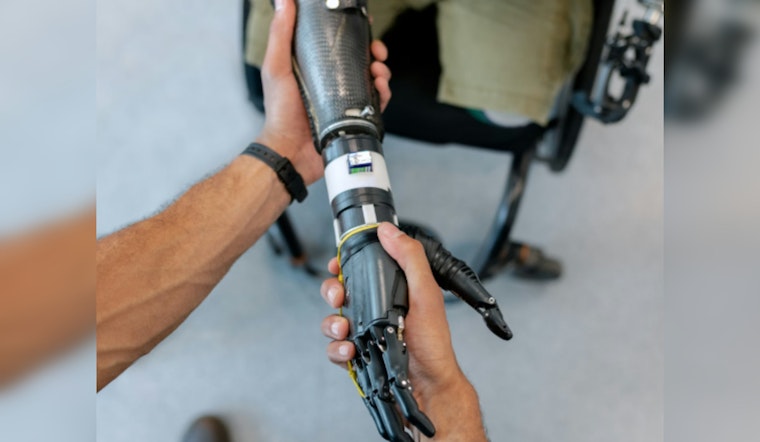
In an Austin lab this week, a homegrown neurotech startup is betting it can turn intention into motion. Phantom Neuro says it has developed a minimally invasive implant that translates muscle signals into natural control of robotic hands. The company’s Phantom X platform reads tiny electrical currents in remaining muscles and converts them into complex movements, with the goal of smoother, more intuitive control than today’s myoelectric systems. Company leaders say human implants and the first clinical work are slated to begin in 2026.
According to KEYE/CBS Austin, founder and CEO Connor Glass told reporters, “I’d say we’re extremely close. Our technology is actually pretty much done.” The station also profiled a user, Alex Smith, who described using Phantom X to control gestures “automatically just by thinking about it” without buttons or mode-switching.
How the System Picks Up Intent
Phantom Neuro’s website describes Phantom X as a low-risk, multielectrode EMG sensor array that is implanted just beneath the skin over muscle tissue. The implant is paired with a telemetry module and an external wearable that sends decoded signals to a prosthetic controller. Per Phantom Neuro, the setup is designed to sidestep brain or deep-nerve surgery while using algorithms to translate natural muscle intent into real-time movement.
Clinical Trials and the 2026 Clock
The company has moved toward first-in-human testing. A ClinicalTrials.gov entry (NCT07325708) lists an early-feasibility study sponsored by Phantom Neuro with sites in Victoria, Australia, at Cabrini Health (Malvern) and ProMotion Prosthetics (Moorabbin). The registry shows a January 2026 start, an enrollment target of about 10 participants, and primary completion expected in late 2026, with safety and functional performance named as the primary outcomes.
Funding and Big-Name Backing
The startup has pulled in strategic capital to fuel that push. German prosthetics maker Ottobock led a $19 million Series A in April 2025 to accelerate trials and commercialization, Ottobock said in a news release. The company has also drawn attention and small awards from U.S. defense programs and other investors, which reporters say have helped validate the technology’s dual-use promise, according to Business Insider.
What Early Users Say It Feels Like
Early users profiled by KEYE/CBS Austin say Phantom X feels noticeably different from conventional systems that force them to toggle modes or press buttons to change grips. Alex Smith, who lost his arm in a boating accident, told the station he could point, count, and perform other gestures “automatically just by thinking about it,” describing the experience as more intuitive and less like piloting a gadget.
Regulatory Fast Lane, With Caveats
Phantom Neuro announced that Phantom X received Breakthrough Device and Targeted Acceleration Pathway (TAP) designations from the U.S. Food and Drug Administration in 2025, a status the company says helps speed regulatory engagement. The FDA’s Breakthrough Devices Program provides prioritized review and early agency interaction but does not substitute for the clinical evidence required to prove safety and effectiveness, per FDA guidance.
What Austin Should Be Watching
Headquartered in Austin and spun out of Johns Hopkins research, Phantom Neuro has opened a registry and is lining up surgical partners and prosthetists as it moves toward implants and human testing. Local clinicians, prosthetists, and amputee groups will be watching trial enrollment, surgical feasibility, and real-world wear time as the Australian study proceeds. If the registry’s schedule holds, early results could arrive by late 2026, potentially giving Austin a front-row seat to one of the more futuristic prosthetics tests around.


