

























































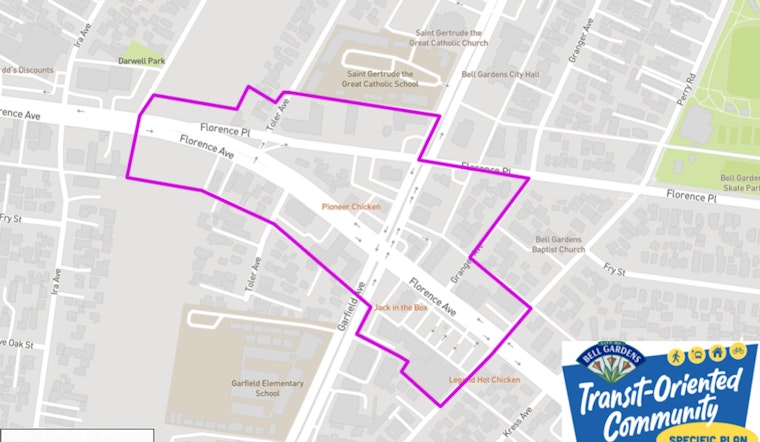
Bell Gardens is looking to give the busy commercial strip around Florence and Garfield Avenues a serious remix, clearing the way for denser housing while keeping neighborhood storefronts in the picture. Under a draft Transit-Oriented Communities (TOC) Specific Plan covering about 23 acres, the city’s environmental documents say the area could ultimately support roughly 400 new homes and about 100,000 square feet of commercial space.
The public review draft and related materials are posted on the City of Bell Gardens planning page. The proposal would rezone properties along Florence Avenue, Florence Place and Garfield Avenue, and the package includes a Draft Initial Study / Mitigated Negative Declaration plus a Program of Projects that lays out specific housing opportunity sites and the infrastructure upgrades the city says would be needed to handle new development.
What the plan would allow
As detailed by Urbanize LA, the draft carves the roughly 23 acre area into five districts with different height limits. The Mercado District at the southeast corner would keep an existing supermarket in place while allowing buildings up to 80 feet tall, or about six stories. The Paseo North and South zones at the northeast corner would top out at three stories, or 40 feet, while Florence Place would allow four stories at up to 55 feet. The South Florence district would be held to three stories, or 40 feet.
In the middle, a small El Corazon parcel is mapped as a single story, roughly 22 foot tall mobility hub and public open space. Urbanize LA also reports that Bell Gardens is using Caltrans grant funding to help pay for the planning work, a reminder that state transportation dollars are increasingly tied to land use changes around transit and key corridors.
The city is framing the TOC push as a streets and access makeover as much as a zoning rewrite. The draft describes a goal to “transform the area around the intersection of Garfield Avenue and Florence Avenue into a vibrant, pedestrian friendly community,” with wider sidewalks, fewer driveways cutting across walkways and steps to tamp down truck traffic. The public review files on the City of Bell Gardens site include design objectives, community engagement materials and the environmental checklist that backs the plan.
Housing capacity and retail
According to Urbanize LA, the draft environmental study finds that the new rules could yield roughly 400 homes, in a mix that could include townhomes, apartments, small lot houses, live work spaces and micro units. Retail and other commercial uses are slated to stick around, and Urbanize LA notes the plan keeps the commercial footprint at about 100,000 square feet while explicitly preserving the supermarket in the Mercado District.
Funding and regional context
State planning grants are helping fuel a wave of TOC studies and corridor specific plans across California. Caltrans’ public list of 2024–25 Sustainable Transportation Planning grant awards shows multiple Los Angeles area cities landing money for station area planning and similar efforts. Those statewide grant programs are the kind of funding source local governments have tapped to cover the technical work required to overhaul zoning around transit and major routes.
What happens next
The city is taking public comments on the draft TOC Specific Plan through March 9, 2026 at 6:00 p.m., and says it will use community feedback to refine the proposal, according to the City of Bell Gardens. Staff will then assemble the comments and bring the plan, along with responses to environmental questions, to the Planning Commission and City Council for formal hearings and potential adoption later in the year.
If the council ultimately signs off on the specific plan, the new zoning would simply set the ground rules for what can be built. Any actual housing or mixed use projects would still need developers to submit detailed plans and run through a separate round of project approvals and permits before any shovels hit the dirt.





