

























































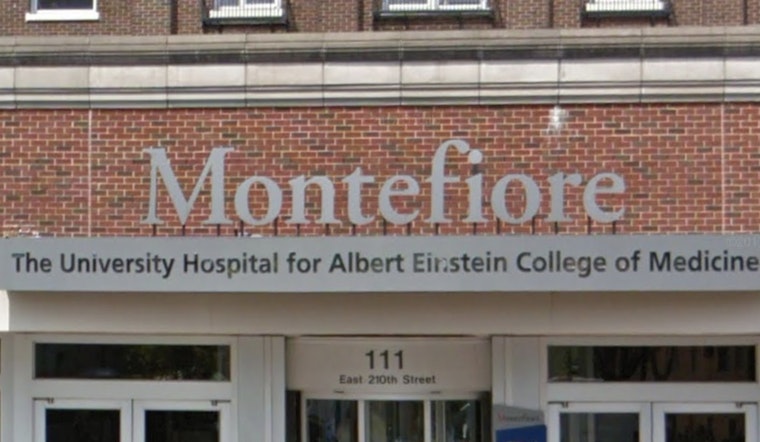
Montefiore is moving ahead with big plans in the East Bronx, filing city applications to rezone parts of its Montefiore-Einstein campus in Morris Park to clear the way for a 20-story medical pavilion. The tower would reach roughly 354 feet and bring about 1.6 million square feet of hospital space, including approximately 420 inpatient beds, dedicated surgery and imaging floors, and an expanded emergency department with 76 treatment rooms. The pavilion would link directly to the existing Weiler building on the east campus and add about 800 parking stalls. This latest design follows earlier, taller versions that Montefiore trimmed after community pushback.
As reported by Crain's New York Business, planning documents show that Montefiore has asked the city to rezone campus parcels and to change the city map in order to demap small stretches of streets that cut through the proposed footprint. The filing spells out the program details, including the bed count, the new operating and imaging floors, and the larger emergency department, and it notes operational items such as provisions for roughly 800 parking spaces, with up to 50 spaces set aside for residents’ occasional use. The documents also describe how the new pavilion would physically connect into the Jack D. Weiler Hospital complex on the east campus.
Where the Project Fits Into East Bronx Rezoning
The application arrives at the same time as broader land-use changes in the East Bronx. In August 2024, the City Council signed off on a package that rezoned roughly 46 blocks around proposed Metro-North stations and paired those changes with infrastructure commitments intended to spur growth. That neighborhood rezoning reshaped what kinds of institutional and residential projects are possible in and around Morris Park and made larger campus planning moves like Montefiore’s more feasible.
What Montefiore Says
Ruben Díaz Jr., Montefiore’s senior vice president of strategic initiatives and the system’s former Bronx borough president, has framed the proposal as a way to keep specialty care close to Bronx residents while building local jobs and training pipelines. He said it will bring "best-in-class" care to the borough, as reported by Crain's New York Business. Montefiore officials have been walking community groups through different iterations of the design while tweaking the height, massing, and campus map.
Land-Use Review and Timeline
Before any construction can begin, the project must be certified by the Department of City Planning and go through environmental review. Once certified, it enters the city’s Uniform Land Use Review Procedure (ULURP). City resources note that ULURP typically runs about seven months and includes review periods for the local community board, the borough president, the City Planning Commission, and the City Council, with environmental review taking place alongside that public review.
Neighbors and Height
Neighbors and community organizations have kept a close eye on Montefiore’s outreach and shifting designs. Earlier presentations featured larger schemes that drew vocal pushback and led the system to reduce the tower’s height. Local reporting on those earlier proposals described a taller life-sciences or medical tower concept that was scaled back as Montefiore refined the plan in response to feedback.
Why It Matters
Hospital leaders say the pavilion would expand local access to specialty care, cut down on trips to Manhattan for some procedures, and create both construction jobs and long-term clinical positions. Montefiore’s campus pages and prior modernization projects highlight the system’s role as a major employer and clinical anchor in the borough, which officials say adds urgency to boosting on-campus capacity.
If the Department of City Planning certifies Montefiore’s application, the formal public review process will begin and environmental documents will be posted, with community-board hearings scheduled and the ULURP clock officially started. Residents and local groups will have multiple chances to review the plans, respond to environmental findings, and press for design changes or mitigation measures before any final city votes are taken.





