

























































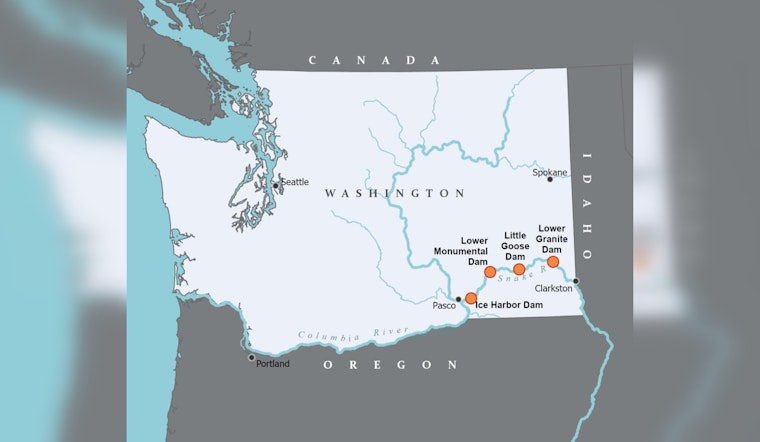
Washington’s transportation planners are quietly running a what-if that could remake how grain and other goods move across the state’s dry side. WSDOT has launched an online open house tied to a statewide study that looks at what happens to freight if the four Lower Snake River dams come out and barges disappear from that stretch of the river. The agency’s modeling zeroes in on commodities like grain, fertilizer and wood, and tests how rail terminals, new track and peak-season truck traffic would have to ramp up to keep goods flowing. For communities across southeastern Washington, that could mean new unit-train facilities, heavier harvest traffic on county roads and years of wrangling over mitigation plans.
What WSDOT Is Modeling
To game out those ripple effects, the study leans on a Total Logistics Cost (TLC) model that estimates how commodity flows would change if barges could no longer use the Lower Snake. The analysis compares a 2020 baseline to a 2045 future with and without the dams. It lays out seven scenarios, ranging from a no-build benchmark to mitigation options that add unit-train terminals, shortline facilities and rail-line upgrades, then reports on annual grain tonnage, barge and train volumes and peak daily truck counts, according to WSDOT.
Why The State Ordered The Study
Lawmakers in Olympia told WSDOT to put hard numbers to what a shift away from barge traffic would actually cost on land. The Washington Legislature directed the agency to analyze highway, road and freight-rail needs and to estimate both the financial and carbon-emissions costs if freight moves to trains and trucks instead. That marching order, along with funding for the work, is laid out in ESHB 2134, which calls for detailed volume estimates, scenario-building and robust public and tribal engagement, according to the Washington State Legislature.
What It Could Mean On The Ground
Local grain handlers, ports and advocacy groups have warned that losing Snake River barge service could push thousands of tons of freight onto rail and highways, driving up peak-season traffic and local infrastructure costs. That is no small tweak for rural roads that already feel every harvest rush.
The stakes go beyond logistics. NOAA Fisheries, in a 2022 rebuilding report, identified breaching the Lower Snake River dams as one of the highest-impact actions for restoring interior Columbia Basin salmon and steelhead, according to NOAA Fisheries. That ecological backdrop helps explain why the transportation study has drawn such close scrutiny from farmers and tribes. Stakeholder concerns and early reactions have been chronicled by groups including the Washington Association of Wheat Growers and local outlets, per the Washington Association of Wheat Growers.
How To Weigh In And What Happens Next
The study’s online open house and scenario materials are available through February 9, 2026, and WSDOT says public comments will help the team refine a new Scenario 8 before it moves into Phase 3 and prepares a final report for the Legislature later this year, according to WSDOT. Questions about the project can be sent to study lead Jim Mahugh at [email protected].



