

























































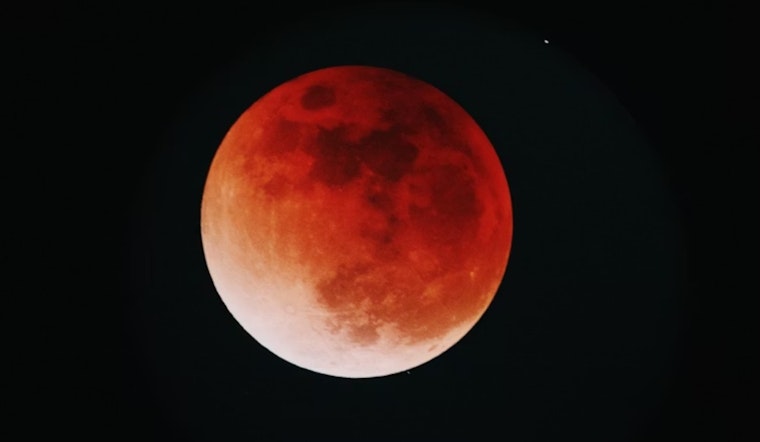
San Diego night owls are getting a true cosmic double feature this week: a planetary parade on Saturday evening followed by a total lunar eclipse in the predawn hours of next Tuesday. Venus and Jupiter, along with possibly Saturn, should be easy to spot with the naked eye shortly after sunset, while dimmer Uranus and Neptune will need binoculars or a small telescope. The total lunar eclipse will peak between about 3 a.m. and 4 a.m. Pacific time, when the full Moon can slip into a coppery red during totality.
Locals are already plotting where to spread out their blankets. David Wood of the San Diego Astronomy Association pointed out that Jupiter will be the brightest object in the sky other than the Moon, and San Diego State University astronomy professor Douglas Leonard warned that the parade’s viewing window will be brief, according to CBS 8.
When To Look
The planetary parade builds through February and hits its peak this Saturday evening. Your best bet is to start looking roughly 30 minutes after sunset, when several planets will line up along the ecliptic low over the western horizon.
On a clear evening, Mercury, Venus, Jupiter and Saturn should be visible to the unaided eye in many locations, while Uranus and Neptune will likely demand binoculars or a telescope. Mercury will be hugging the horizon, so it could be a blink-and-you-miss-it target.
For a concise month-by-month sky primer, check The Planetary Society. For local how-to tips tailored to San Diego viewers, see NBC 7 San Diego.
Total Lunar Eclipse: What To Expect
The total lunar eclipse arrives in the early hours of Tuesday, March 3, as the Moon passes through Earth’s shadow in a series of penumbral, partial and total phases. According to NASA, totality for Pacific time observers should run roughly from 3:04 a.m. to 4:02 a.m. PST, with the umbral (partial) phase kicking off near 1:50 a.m.
During totality, the Moon often takes on a coppery or reddish hue as sunlight filters through Earth’s atmosphere and bends into the planet’s shadow. It is dramatic, a little eerie, and completely safe to watch with the naked eye.
How To Watch From San Diego
For the parade, choose a beach, bluff or park with a clear western horizon and minimal obstructions. Bring binoculars if you have them - city light pollution will not stop the Moon from reddening during the eclipse, but optics will make the dimmer planets, including Uranus and Neptune, much easier to track down.
Local clubs and outreach programs are lining up viewing events. CBS 8 noted that the San Diego coast should be one of the better spots in the nation to catch both sky shows, and the San Diego Astronomy Association posts public star-party information at SDAA.
Cloud cover is the biggest wildcard, as usual. Check the local forecast and have a backup location a little inland or uphill if the marine layer looks ready to crash the party.
If you cannot get outside, online coverage will have you covered. Griffith Observatory will carry the action and offer minute-by-minute updates. Space.com will also provide detailed guides and timing breakdowns, and NASA will feature eclipse coverage across its platforms.





