

























































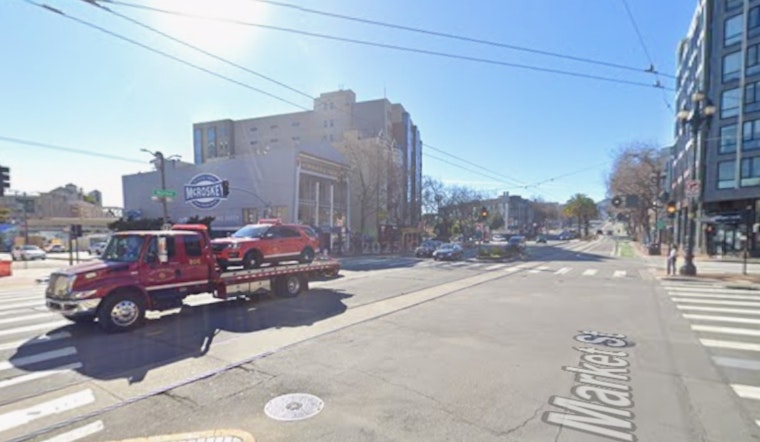
The old McRoskey Mattress building at 1687 Market Street is officially coming apart at the seams. Demolition crews this week began tearing into the 1925 structure to make way for what backers are billing as San Francisco’s first apartment complex built specifically for low‑income artists, complete with places to sleep, rehearse, and perform under one roof.
The nonprofit Artists Hub on Market, led by SFJazz founder Randall Kline, is teaming up with Mercy Housing on the project, which has already split preservationists and arts advocates over whether the vintage façade should have been saved or sacrificed in the name of more units.
According to the San Francisco Chronicle, demolition kicked off this week on the privately financed development, which is backed by a major philanthropic gift. The total tab is pegged at roughly $140 million and, notably, will be covered without any city funds. Developers say the corner of Market where Hayes Valley, Civic Center, the Castro, and the Mission all converge is meant to become a central hub for emerging artists and small arts groups.
Project plans call for 94 affordable rental apartments for artists, with a mix of studio, one‑bedroom, and two‑bedroom units. The building is also slated to include practice and rehearsal rooms, an on‑site black‑box theater, arts offices, and community space. Shared perks in the design include a roof deck, secure bike parking, and a ground‑floor café intended to keep the block busy during the day. The theater and rehearsal spaces are expected to be available for rent at affordable rates to other local arts organizations, according to 1687 Market.
How the project cleared city review
This build is moving forward under California’s streamlined rules for affordable housing, with Assembly Bill 2011 opening a ministerial approval path that trims environmental and discretionary reviews for qualifying projects. KQED details how AB 2011 speeds construction when a development is 100% affordable.
Local planning and permitting reports show demolition permits were filed in mid‑2025 as the team geared up to start construction in early 2026, as per SF YIMBY.
Who can live there
The building is slated to serve artists, production‑side arts workers, arts administrators, and their families who meet income limits. All households must qualify at or below 80% of the area median income.
San Francisco supervisors have moved to create an Artist Housing Certification Program that would establish a registry and objective criteria for would‑be tenants. City leaders say that the framework is intended to guide leasing for this development and others like it. Public meeting records outline the program’s sponsors and scope.
Preservationists push back
Preservation advocates are far from thrilled about the McRoskey building disappearing. The developer’s materials state that keeping the original façade would have significantly reduced the number of affordable units that could be built. Preservation groups, for their part, argue that streamlined state law left them with limited leverage to push for a compromise.
The San Francisco Chronicle reports that studies found preserving the façade would have cut the unit count and increased costs, a trade‑off that has quickly become the heart of a neighborhood fight over how much history to keep when the city says it needs housing.
What’s next
Project updates note that planning approvals are in place and that construction is expected to run through 2028, with the development team and Mercy Housing coordinating community outreach and advisory efforts along the way.
The group also says it will work with the Arts Commission and other partners on the artist certification process and DAHLIA applications for future leasing rounds. The project website is set to carry timelines and application details as they firm up, according to 1687 Market.





