

























































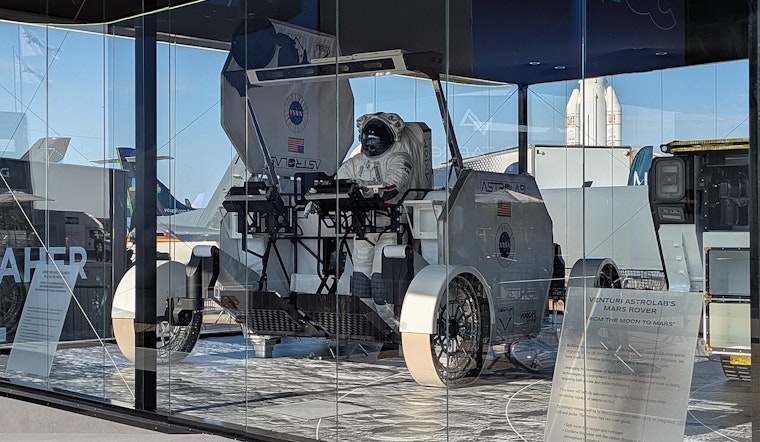
A San Antonio startup wants to handle the dirty work on the Moon. Astroport Space Technologies says it has taken lunar construction from concept to hardware, showing off a prototype excavator that bolts onto a rover and partners with Venturi Astrolab to outfit Astrolab’s FLEX platform with swap-in construction tools. The companies say those machines could clear and level regolith, build landing pads and roads, and help shape vaults for a surface nuclear reactor, positioning the local firm as a contender to provide heavy equipment for a future U.S. lunar outpost.
Field demo and partnership
In a recent field test, Astroport ran a prototype "lunar excavator" and signed a memorandum of understanding with Venturi Astrolab to set up what they call a "science-to-construction" pipeline, according to Military Aerospace. The outlet reported that Astrolab’s FLEX rover used its modular arm and payload interfaces during the exercise as the two companies worked on how to turn lab-grade hardware into job-site machinery for the Moon.
What the tools do
Video and coverage from the San Antonio Express-News show a four-wheeled rover rolling up to a cylindrical drum excavator, latching on, then using the rotating drum to scrape and collect layers of simulated regolith so the material can be sieved and processed for construction. The drum is described as the first in a planned family of interchangeable tools that also includes a drill, trencher, leveling blade, and shovel. In that coverage, CEO Sam Ximenes said, "Leading with this successful excavator demo proves that our technology is no longer theoretical; it is operational."
Why the 2030 target matters
A White House executive order dated Dec. 18, 2025 calls for an initial lunar outpost and a lunar surface reactor by 2030, a policy the administration frames as a way to speed up private-sector work on infrastructure for the Moon, according to The White House. Ximenes told the San Antonio Express-News that "the executive order for getting a lunar reactor on the Moon by 2030 is now driving us and pushing us," adding that the directive has effectively hit the fast-forward button on the company’s schedule.
Local jobs and NASA backing
Founded in 2020, Astroport has been building out lab and test facilities at Port San Antonio as it moves from research toward flight hardware. Port San Antonio lists the Tech Port campus as the company’s base, while federal award records show Astroport has landed multiple NASA SBIR and STTR contracts related to regolith-handling and site-preparation technologies. The Phase II SBIR award description outlines work on bulk regolith management, brickmaking, and concepts for landing and launch pad construction in support of Artemis missions. Local coverage has also highlighted university partnerships that feed into the company’s research pipeline.
What’s next
Venturi Astrolab announced in 2023 that its FLEX and FLIP rover system is booked on an upcoming SpaceX Starship mission and is designed to haul large payloads and modular experiments to the lunar surface, according to Astrolab. Under their memorandum of understanding, the two companies say their near-term priorities include more integration testing, building flight-ready hardware, and additional field trials, per materials released through PR Newswire.
Local significance
For San Antonio, the work reflects Port San Antonio’s effort to attract more aerospace R&D and small-batch manufacturing tied to federal programs. Company representatives and local leaders say the jump from sandbox demonstrations to flight hardware could mean new testing and manufacturing jobs, while giving the region a seat at the table as a lunar-infrastructure economy starts to take shape.





