

























































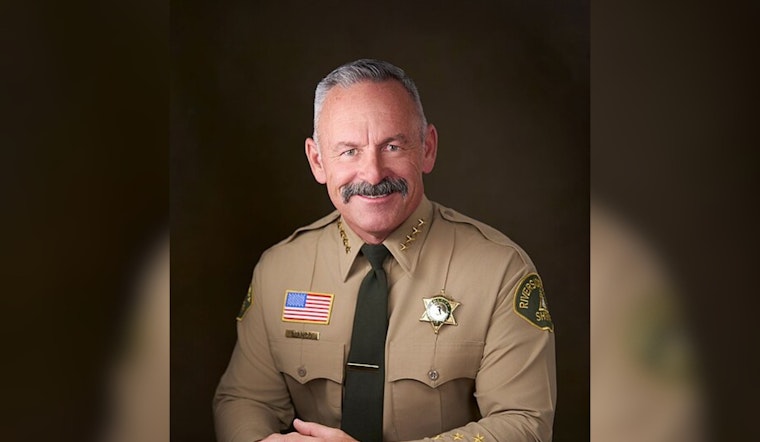
Republican gubernatorial contender Chad Bianco is facing awkward questions over a cluster of big checks out of Corona, where two sibling-run companies each cut his campaign the maximum donation allowed under state law. The hitch: if regulators decide those firms are effectively one family-controlled donor, the combined money could blow past California's strict limits.
At the center of the issue are Downs Energy and M&D Development, both operated by members of the same family. Campaign records show each company supplied Bianco with what, on paper, looks like its own set of maximum contributions, raising the question of whether they should instead be treated as a single funding source.
According to the San Francisco Chronicle, filings show Downs Energy gave Bianco $39,200 on March 7, 2025, and another $39,200 on Dec. 30, 2025. M&D Development recorded two contributions of $39,200 on Dec. 30, 2025. Those same entries appear in public campaign databases, as listed by Transparency USA. Taken together, the two companies' $78,400 totals would amount to roughly $156,800 coming from a single family orbit if regulators decide the donors are not truly independent.
Downs Energy, a fuel distributor with roots going back to the 1940s, changed hands last year. The company was sold in September to a subsidiary of Pilot Travel Centers, according to a press announcement from Matrix Capital Markets Group.
What California Law Requires
The Fair Political Practices Commission (FPPC) caps contributions to a gubernatorial candidate at $39,200 per election. In practice, that means a single source can give $39,200 for the primary and another $39,200 for the general, but not more.
Under state rules, the total from related entities can matter as much as the name on the check. Per regulations published on Justia, contributions from entities that are “directed and controlled” by the same individual or group must be aggregated and reported as coming from a single source. Whether Downs Energy and M&D Development meet that test is the legal hinge for any potential enforcement.
Donors and Campaign Response
Bianco's campaign has so far stayed quiet about the Corona checks. His team did not respond to questions about the donations, and representatives for the companies did not immediately comment, according to the San Francisco Chronicle.
Dan Schnur, a UC Berkeley political scientist and former FPPC chair, told the paper that without more detail about who controls the companies and how the donations were arranged, the public is operating in something of a fog.
Context and Political Stakes
The timing of the controversy is not ideal for Bianco. The Riverside County sheriff is one of the leading Republicans in California's crowded governor's race and is already under a microscope for his role in an election-related showdown.
Bianco's office seized hundreds of thousands of ballots from a 2025 special election, an extraordinary step that has fueled legal challenges and partisan outrage. Reporting from AP News details the ballot seizure and the subsequent court filings that followed.
On the money side, public campaign databases show Bianco has proven to be a strong fundraiser. Transparency USA lists more than $3.7 million in contributions reported through the end of 2025, with the Corona donations folded into that total.
Legal Implications
If the FPPC ultimately decides that Downs Energy and M&D Development are effectively one donor for legal purposes, the combined sums could exceed California's statutory limits and trigger an administrative review. Possible outcomes include fines, orders to refund excess contributions, amended campaign filings, and public sanctions.
The aggregation rules also require campaigns to disclose who actually controls any entities whose donations are combined, so a ruling could force more transparency about the family ties behind the checks.
In the short term, the clearest early signals will likely come not from a dramatic hearing but from paperwork. Watch for amended filings, formal advice requests to the FPPC, or a public explanation from the campaign or the companies that spells out whether these donations were structured as independent. Any formal FPPC inquiry or revised campaign report could settle the legality question before voters head into the June primary.





