

























































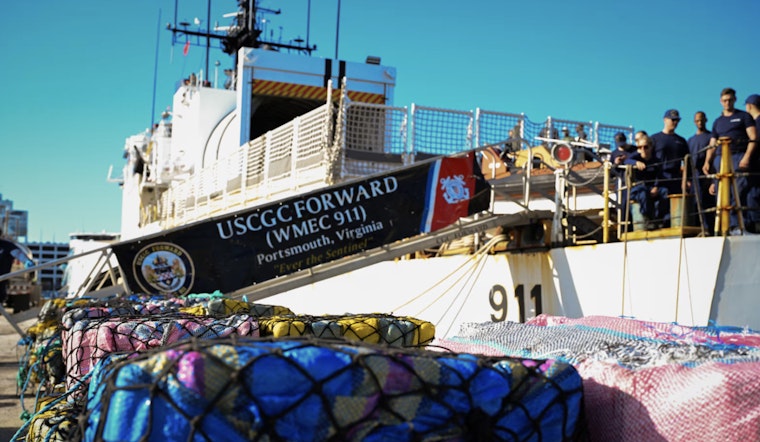
On Thursday, Port Everglades once again turned into a front-row seat for the drug war at sea, as the U.S. Coast Guard and federal partners offloaded about 6,750 pounds of seized cocaine. Officials pegged the haul at roughly $49.3 million in street value. Wrapped bales were stacked on pallets at the Fort Lauderdale port while crews got them ready for federal processing and disposal, part of a months-long effort to stop big shipments long before they can reach U.S. shores. Port Everglades has repeatedly served as the go-to staging area for these kinds of offloads.
According to NBC 6 South Florida, the cocaine came from two separate interdictions. In a Feb. 7 case, an aircraft helped spot and disable a vessel carrying about 6,435 pounds of cocaine. A second interdiction on March 8 yielded roughly 130 pounds. NBC 6 reported that both loads were brought ashore at Port Everglades on Thursday and turned over to federal partners as part of ongoing counter-drug patrols in the eastern Pacific.
Part of a Wider Pacific Viper Push
Both seizures are linked to Operation Pacific Viper, a Coast Guard surge that began last August and has racked up more than 200,000 pounds of cocaine seized in the Eastern Pacific. In a Feb. 5 statement, the U.S. Coast Guard described the campaign as producing "record-setting interdictions." The operation pairs large cutters with HITRON helicopters and long-range patrol aircraft, a combination designed to detect and disable suspected smuggling vessels far from U.S. shores.
Officials say the steady drumbeat of interdictions has cut into cartel revenue and spun off intelligence that can be used in broader investigations. Each bust is not just a big pile of contraband on a dock, they argue, but also a source of data points for the agencies trying to map and disrupt trafficking networks.
Why Port Everglades Keeps Being the Offload Point
Port Everglades has become a familiar backdrop for these high-profile displays. Local coverage and official releases have documented multiple major cocaine offloads at the Fort Lauderdale port in recent months. Coverage of high-value offloads and other multi-hundred-million-dollar hauls has highlighted how federal agencies consolidate seized loads there. The pattern underscores how maritime interdiction has become a central line of defense against bulk cocaine shipments bound for South Florida.
After the cameras are gone, the process turns methodical. The Coast Guard typically transfers seized narcotics to federal partners for testing, evidence processing and eventual destruction. The agency has said the Drug Enforcement Administration is among the partners that take custody of the bales for those steps. U.S. Coast Guard officials also note that interdictions generate evidence and intelligence for prosecutors.
Any criminal charges tied to at-sea arrests from these cases are typically handled by federal prosecutors in the Southern District of Florida. Spokespeople said there were no charging announcements made at Thursday’s offload, leaving that part of the story to play out later in a federal courtroom rather than on the Port Everglades dock.





