

























































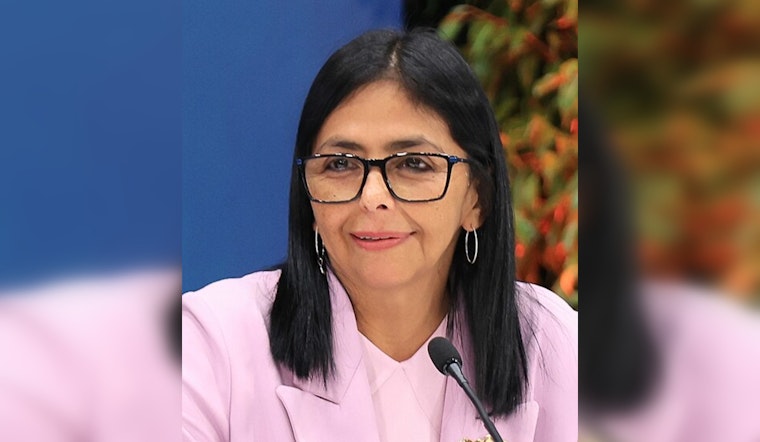
Venezuela’s interim president Delcy Rodríguez used a video link from Caracas on Wednesday to make a rare, straight-to-the-point pitch to U.S. financiers gathered in Miami: come see the country and put money to work. She framed it not as a political thaw but as an economic reset, arguing that new rules at home and fresh U.S. licensing have lowered the legal hurdles that scared off investors for years.
Her remarks were beamed into the FII Priority summit at the Faena complex in Miami Beach, a three-day investor gathering that pulls in global fund managers, oil executives and policy makers. The event is billed by the FII Institute as a forum for cross-border capital and technology talks, and coverage described a large international crowd of investors and officials in attendance. According to EL PAÍS, Rodríguez addressed the room by video from Caracas.
Rodríguez’s sales pitch leaned heavily on a recent legal overhaul. Her government pushed through a partial rewrite of Venezuela’s Hydrocarbons Law in late January that formally opens parts of the oil sector to private and foreign players and adds arbitration and other investor protections. The reform was published in the official Gaceta and summarized in legal briefs, which note that the changes are meant to let companies participate directly in exploration, production and commercialization. Rodríguez told the Miami audience that, under the new framework, some commercial structures let investors negotiate terms that capture a large share of a barrel’s commercial value. According to the Gaceta Oficial notices and related summaries, the reform is designed to showcase projects that visiting investors can review firsthand, a point she underscored in her remarks. Reporting on her comments and the pitch to investors appears in the Miami Herald.
Washington has already given a cautious green light for some capital flows. In late January and February, the U.S. Treasury’s Office of Foreign Assets Control issued a run of Venezuela-related general licenses authorizing certain oil-sector transactions and, in narrow cases, allowing specific companies to restart activities under strict conditions. The licenses permit negotiations and contingent contracts in some situations but keep OFAC closely involved in counterparties, payments and downstream approvals. The OFAC notice is the baseline for those steps, and legal advisories spell out the compliance checks companies are expected to clear before they put real money on the table. See the OFAC statement and subsequent legal analysis for the detailed fine print.
The potential prize is huge. Venezuela holds roughly 303 billion barrels of proven crude oil, the world’s largest proved reserve base, although most of it is extra heavy Orinoco crude that needs diluents and significant processing before it can be sold. Rodríguez argued that the new fiscal and contractual setup, plus operational work in the fields, can lower production costs and entice major firms back into the country, a line she repeated in Miami while pushing closer commercial ties with the United States. The reserves figure is drawn from the U.S. Energy Information Administration’s country analysis, while coverage of her remarks and commercial claims appears in the Herald’s reporting.
Investor Red Flags And Legal Checks
Lawyers and compliance officers are already warning that the new law and U.S. licenses are only the opening act. The Hydrocarbons Law’s investor-friendly language on arbitration and fiscal flexibility will have to be backed up by clear implementing rules and predictable enforcement. On the U.S. side, OFAC’s general licenses come with tight caveats over who can do what, and under which precise terms.
Firm memos and sanctions analyses stress that serious investors will want pre-approved contract language, explicit OFAC sign-offs on upstream work and enforceable dispute-resolution clauses before they commit serious capital. In other words, the PowerPoint pitch is not enough. For a closer look at the licensing framework and the practical hoops companies must jump through, legal advisories from major law firms and sanctions specialists set out the main requirements.
Why Miami Matters
Miami has become the stage for this particular courtship. Global investors converge here to size up political risk and meet decision makers, and the Faena forum is the kind of high-visibility setting Rodríguez used to launch a broad pitch. Organizers and reporters point out that the summit doubles as a speed-dating hub for private meetings between executives and Venezuelan envoys, turning the conference agenda into an informal marketplace for due diligence and side deals. The FII platform itself casts the city as a bridge between Gulf and Western capital that is looking for ways into Latin America.
Whether the money actually follows will come down to three tests: how quickly OFAC and U.S. counsel can clarify the nuts and bolts of new upstream deals, whether Venezuela’s government issues clear implementing rules and credible protections, and whether companies feel they can keep people and operations safe on the ground. Until those boxes are ticked, large energy players are likely to move slowly, even as smaller service providers and trading houses begin quietly scouting the opportunities Rodríguez just advertised from afar.





_(cropped).jpg)