

























































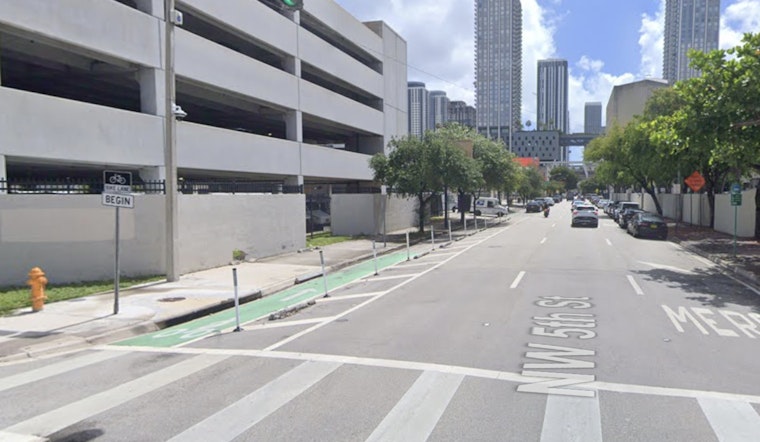
What was supposed to be a safe route for cyclists on Northeast 5th Street in downtown Miami is increasingly looking like a parking lot with a bike lane painted through it. The protected corridor, a short one-way funnel toward PortMiami, is routinely clogged by delivery trucks, parked cars and idling vehicles. Riders say that mess regularly forces them out of the lane and into fast-moving traffic, and first responders are raising alarms too.
District 2 Commissioner Damian Pardo says the city is now looking at a fairly simple, if not entirely uncontroversial, fix: painting sections of the sidewalk to create an "elevated area" that cyclists and pedestrians would share. Pardo told CBS Miami he expects to get an update on possible solutions in roughly a month.
The Downtown Miami Bike Network, a joint project between the city and Miami-Dade County, brought protected east-west lanes to NE 5th and NE 6th Streets as part of a micromobility rollout that kicked off in April 2021 and wrapped up most major work in early 2022. According to the Miami Downtown Development Authority, the effort delivered about 6,050 feet of separated bike lanes and another 850 feet of parking-protected lanes, and crews have started adding marine-grade planters and other barriers to keep cars out of buffers, per Miami DDA.
So far, though, the hardware on the ground has not fixed the day-to-day reality. Drivers still park, load and idle in and around the supposedly protected lanes, sending cyclists into car traffic to get by. Miami Police and Fire-Rescue have told city staff that congestion at times blocks access to a fire station entrance and a loading zone at a nearby federal detention center, according to CBS Miami.
Crash Trends Point To A Bigger Problem
Data from the Miami-Dade Transportation Planning Organization suggest the trouble on NE 5th Street is part of a broader safety problem. Bicycle and pedestrian crashes have been trending upward in recent years, with a noticeable cluster in Miami Beach and downtown, including the NE 5th Street stretch. The TPO's 2050 Bicycle-Pedestrian Master Plan maps those hot spots and analyzes crash patterns, work that local officials say has helped drive the push for stronger protections on busy downtown corridors, per Miami-Dade TPO.
Raised Cycle Tracks Are An Established Safety Tool
Federal guidance and industry design manuals point out that vertically separated cycle tracks, whether built at sidewalk level or raised slightly above the street with curbs or planters, usually provide more protection than paint-only lanes. They are also known to cut down on common risks like dooring. The Federal Highway Administration's Separated Bike Lane Planning and Design Guide spells out the trade-offs and menu of design options for raised and protected lanes and recommends physical separation where traffic speeds and volumes justify it, according to FHWA.
People who actually live and work downtown are split on what should come next. Some residents worry that sidewalk-level cycle tracks would just swap conflicts with cars for conflicts with pedestrians. Others argue that anything keeping riders out of fast-moving traffic is a step in the right direction, especially for daily commuters. Businesses and delivery operators are expected to be pulled into the discussion as well, since any redesign will have to grapple with loading access and how strictly rules are enforced.
Pardo has asked staff to come back with specific options and price tags, and city officials say they will coordinate closely with county engineers and the DDA on pilot treatments. Ideas on the table include painted sidewalks, raised curbs, additional planters and tougher enforcement. The DDA notes it has already installed dozens of marine-grade planters along the downtown bike network to discourage drivers from drifting into protected space and says it is prepared to expand those protections as new sections open, per Miami DDA.





