

























































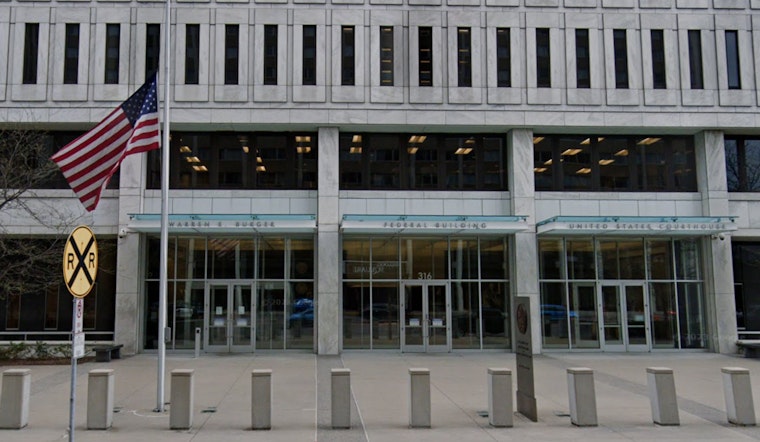
A growing wave of military lawyers is landing inside the U.S. Attorney's Office in Minneapolis, where they are helping prosecute civilian cases in federal court. Legal experts say the move chips away at a long-standing boundary between military and civilian justice that was supposed to stay bright and clear.
Local reporters were the first to spot the shift. As reported by FOX 9, military judge advocates are now working as special assistant U.S. attorneys in Minnesota federal courtrooms, handling ordinary civilian prosecutions. The station's video coverage shows officials and lawyers reacting to the new faces in the courtroom and what their presence might mean.
Federal Filing Challenges the Practice
Not everyone is quietly accepting the change. On March 10, 11 former military lawyers filed an amicus brief in Minnesota federal court asking a judge to remove a military attorney from the case U.S. v. Johnson, arguing that the detail violates the Posse Comitatus Act and service regulations that restrict JAG work to matters with a clear military connection. The filing walks through the history of the Judge Advocate General's Corps and contends that the current details go far beyond past exceptions, according to Protect Democracy.
Precedent in Memphis and Washington
Minneapolis is not alone. The Justice Department has publicly touted similar arrangements elsewhere. In January, a federal press release announced that 20 military lawyers were being sent to the Western District of Tennessee to serve as special assistant U.S. attorneys in Memphis, backing up a "Memphis Safe Task Force." Officials there described the move as a temporary personnel-sharing measure to push through a surge of cases, according to the U.S. Attorney's Office in the Western District of Tennessee.
Experts Say the Scale Is New
Policy analysts report that the Pentagon and the Justice Department have sought dozens of JAG officers for details in Minneapolis, Washington, D.C., and Memphis, and legal scholars say the size and nonmilitary focus of these assignments are unlike anything they have seen before. Georgetown law professor Steve Vladeck told Defense One that the move "raises serious concerns" about pulling military lawyers away from their core duties, while retired JAG officers warn that turning them into frontline federal prosecutors could drag the corps into partisan fights.
Why Minnesotans Are Watching
All of this is landing in Minneapolis at a tense moment. The JAG details are arriving in the middle of a broader federal enforcement surge in the Twin Cities that has already frayed trust between local leaders and federal agencies. That includes an ICE sweep dubbed "Operation Metro Surge," two disputed federal shootings, and the resignation of multiple prosecutors from the U.S. Attorney's Office. A detailed timeline of that escalation and its fallout helps explain why the JAG deployments are getting extra scrutiny in Minnesota, according to CBS News.
Legal Stakes and Statutes
At the center of the brewing fight is the Posse Comitatus Act, a post-Civil War law that generally bars federal military personnel from engaging in domestic law enforcement, along with service rules that spell out when JAG officers can be lent out. Those limits were designed to keep a clean separation between the armed forces and civilian policing, and the Minnesota amicus brief argues that the new prosecutorial details cut against that structure, according to Brennan Center analysis.
What Officials Say and What Comes Next
The Justice Department, for its part, is defending the experiment. A department spokesperson told Defense One that DOJ is "laser-focused on protecting the American people from violent crime" and described the JAG details as short-term backup while certain offices wrestle with heavy caseloads.
The amicus brief in U.S. v. Johnson and related filings are now part of the record in the District of Minnesota, and the judge could be asked to decide whether a uniformed military lawyer can stay on as a federal prosecutor in that case. Whatever the ruling, it is likely to influence whether these details remain a limited, ad hoc tool or start spreading around the country.
How Minnesotans and federal courts respond will help determine whether Judge Advocates remain an emergency staffing patch or become a more permanent feature of the federal prosecution toolbox, and whether new rules will be needed to protect the traditional civilian-military line that has kept soldiers and prosecutors in separate lanes.





