

























































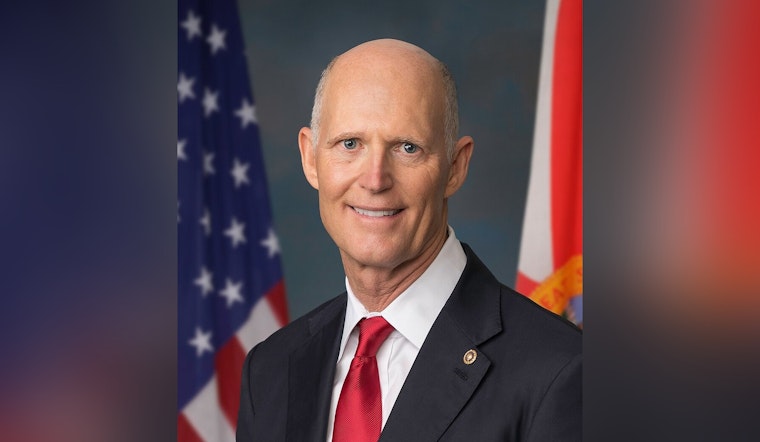
Florida Sen. Rick Scott is pushing a fresh one-two punch on immigration and public safety money, rolling out a pair of bills that would force local governments to make a tough choice: keep sanctuary policies on the books or keep certain federal security grants flowing.
One proposal would overhaul how Urban Area Security Initiative (UASI) dollars are carved up in high-risk metro regions. The other would put new strings on federal help for big-ticket public events, tying it to local cooperation with federal immigration authorities. Scott says any money withheld from noncompliant jurisdictions would be rerouted to Immigration and Customs Enforcement, and he wants the Department of Homeland Security (DHS) to report every six months on how much cash is being held back.
The measures, called the Unifying American Security Interests (UASI) Act and the Sanctuary Jurisdiction Event Security Enhancement Act, are designed to link eligibility for some DHS grants to how closely local law enforcement works with ICE. That includes honoring immigration detainers, joining joint training efforts and sharing information across agencies. Under Scott’s UASI plan, about 30% of UASI funds would be locked into five national priorities: protecting soft targets, supporting task forces, boosting cybersecurity, securing elections and managing border-crisis responses. Any money stripped from cities that refuse to play ball would go to ICE’s Enforcement and Removal Operations. “Democrat politicians are putting illegal aliens first and the American people last,” Scott argued, urging Congress to hold back tax dollars until jurisdictions cooperate, as reported by Tampa Free Press.
How UASI Grants Work
The Urban Area Security Initiative sits under the broader Homeland Security Grant Program and is administered through DHS and FEMA. It is meant to help high-risk, high-density urban areas prepare for and respond to terrorism and mass-casualty threats. UASI money typically pays for planning, specialized equipment, training and the kind of interagency coordination that regional task forces rely on to secure critical infrastructure and major public gatherings.
The program is risk-driven and is supposed to fund capabilities identified through local risk assessments and FEMA’s Notice of Funding Opportunity process. In other words, it is built to shore up security and emergency-response systems, not to quietly subsidize unrelated city services. Program specifics are laid out by FEMA.
Special Events And SEAR Funds
DHS uses a Special Event Assessment Rating, or SEAR, system to decide how much federal muscle to send in for large gatherings, from political conventions to championship games. Higher SEAR levels trigger more extensive federal resources and monitoring.
Scott’s Sanctuary Jurisdiction Event Security Enhancement Act would cut off SEAR-level assistance to any jurisdiction that does not certify full compliance with federal immigration laws. That would effectively force host cities to choose between landing marquee events with federal security support or holding firm on sanctuary policies. The change would alter how federal staffing and incident-management resources are assigned for big events and could shift more of the security bill onto local taxpayers and private organizers, according to Congress.gov.
Legal Hurdles
Efforts to make federal funding contingent on local immigration enforcement have not exactly cruised through the courts. A federal judge in April 2025 barred the federal government from denying or conditioning certain funds to a group of sanctuary jurisdictions, finding that the move likely exceeded executive authority and could amount to unconstitutional coercion.
That ruling, along with a string of lawsuits by cities and counties, is a warning sign for Scott’s bills. If they advance, they would almost certainly face rapid legal challenges, since courts have closely scrutinized past attempts to tie otherwise unrelated grant programs to immigration enforcement. Prior litigation over similar efforts is detailed by AP News.
Where This Fits In
Scott’s push slots neatly into a long-running Republican strategy: use federal purse strings to squeeze sanctuary policies. Similar proposals have surfaced repeatedly on Capitol Hill, including the Stop Dangerous Sanctuary Cities Act, which Sen. Ted Cruz reintroduced in 2025 with a slate of GOP cosponsors that included Scott.
That earlier bill also aimed to make certain grants contingent on cooperation with ICE, underscoring how the fight over conditioning federal aid has become a durable partisan line in the sand. Background on that legislation comes from Sen. Ted Cruz’s office.
Reaction And Stakes
Civil-liberties and immigrant-rights advocates argue Scott’s measures are both coercive and legally shaky. They say tying unrelated federal grants to local policing choices undermines already fragile trust between immigrant communities and law enforcement and could make people less willing to report crimes or cooperate with investigations.
The ACLU has said similar orders and proposals have “no legal basis” and called this style of maneuver a dangerous way to wield the federal budget. City officials, for their part, have warned that crucial grant money for public safety and disaster response could be diverted away from local needs. Those concerns are detailed in reporting by The Guardian.
For now, Scott’s bills are an opening shot. They still have to be formally filed, clear committees and survive what would likely be an immediate wave of legal challenges before they could actually redirect federal funding. Local leaders and event planners in Florida and other major metro regions will be watching to see whether Congress seriously moves on the measures and how DHS chooses to implement any new law.
With courts already weighing in on related executive actions, the fight over Scott’s proposals is likely to stretch far beyond a single floor vote. Whatever happens next, the bills pull the spotlight away from just the border and shine it on how federal homeland-security dollars get carved up in American cities.



.jpg)