

























































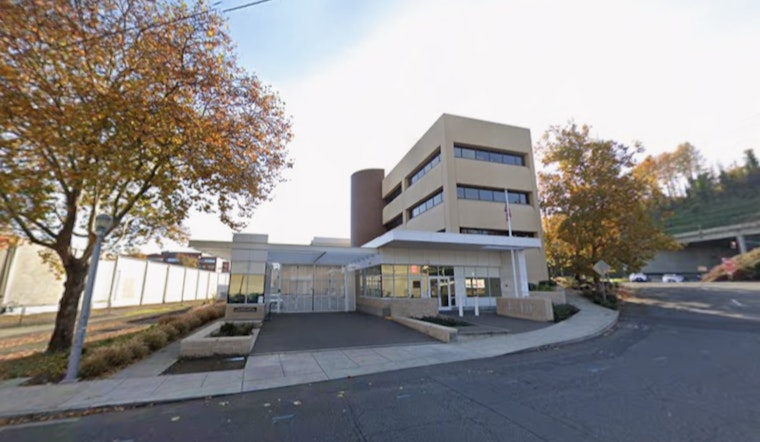
A Portland man who targeted the secure vehicle gate at the U.S. Immigration and Customs Enforcement office in South Portland is headed to federal prison for a year and a half.
On Wednesday, U.S. District Judge Adrienne Nelson sentenced 34-year-old Trenten Edward Barker to 18 months behind bars for setting a fire against the ICE facility’s metal vehicle gate. She also ordered him to pay $8,820 in restitution for the damage and to surrender to U.S. Marshals on April 30, 2026.
According to The Oregonian/OregonLive, Barker pleaded guilty last year to one count of arson of a federal building for his role in the June 11, 2025 incident. Prosecutors told the court that federal officers were able to extinguish the blaze in about five minutes and had urged Judge Nelson to impose a two year prison term.
How Prosecutors Say The Fire Started
As outlined by the U.S. Attorney’s Office, Barker pulled a lit flare from his backpack and hurled it toward a stack of roadway signs, traffic cones, cardboard and lumber that had been piled against the ICE facility’s vehicle gate. The flare ignited the debris and scorched the metal gate before officers put the fire out.
The U.S. Attorney’s Office said the FBI, the Bureau of Alcohol, Tobacco, Firearms and Explosives and the Portland Police Bureau worked the case, building the investigation that ultimately led to federal charges.
Police Response And Arrests
The Portland Police Bureau said officers assigned to monitor the protest outside the South Portland ICE office watched as people stacked flammable materials near the building. According to the city’s account, officers arrested Barker and two others that night.
Police said they also moved a metal pole that had been propped against the lobby entrance, and federal personnel on site quickly doused the small fire before it could spread or cause major structural damage.
Courtroom Clash Over The Sentence
At sentencing, Assistant U.S. Attorney Leah Bolstad pushed for the two year term, arguing that Barker’s actions were more than a political statement. Calling attention to the workers inside the building, she told the court that “bringing a flare to block an exit where people are working is incredibly dangerous,” The Oregonian/OregonLive reported.
Barker’s attorney, Peyton Lee, countered with a request for time served coupled with home detention and location monitoring. Lee told Judge Nelson that Barker was ready to put money on the line, saying his client could immediately pay $3,000 toward restitution.
When it was his turn to speak, Barker addressed the judge directly and said he was “truly sorry” for what happened. More than 20 family members and friends packed into the courtroom to watch the hearing, according to the reporting.
The 18 month sentence lands between the competing requests, reflecting the judge’s view that the fire was serious but stopped short of catastrophic harm.
The case is the latest in a string of federal prosecutions tied to sustained demonstrations at the South Portland ICE office. Authorities have scrutinized protests at the site for more than a year, with multiple arrests and charges already on the books. Earlier coverage documented how four charged with arson and assaulting officers during previous confrontations at the same facility.
Legal Context
Federal arson laws are not gentle. Under Cornell Law School, 18 U.S.C. § 844 makes it a serious felony to maliciously damage federal property by fire, with a typical penalty range that includes a five year mandatory minimum and up to 20 years in prison.
In practice, sentences can land all over the map, depending on the exact charge, the defendant’s criminal history, the terms of any plea agreement and how the judge weighs the specifics of the case. That is how some outcomes, like Barker’s, end up well below the heaviest punishment the statute allows.





