

























































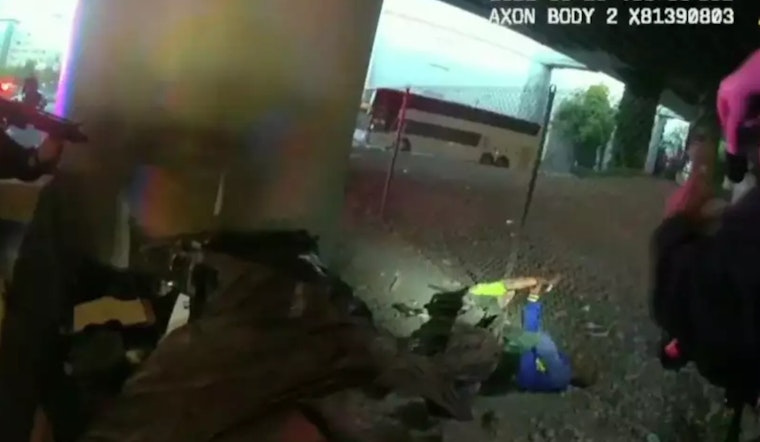
The California Department of Justice has decided there is not enough evidence to criminally charge the San Francisco police officers who opened fire during a May 2022 confrontation beneath the I‑280 overpass at Mariposa and Owens. The shooting left 57-year-old Michael MacFhionghain and 49-year-old Rafael Mendoza dead. MacFhionghain was pronounced at the scene, and Mendoza later died at Zuckerberg San Francisco General Hospital. The finding, issued in early March 2026 after a state-mandated AB 1506 review, closes the DOJ's criminal inquiry while leaving the door open to possible administrative or civil proceedings.
Body-worn camera footage released after the incident shows MacFhionghain positioned over Mendoza while holding a knife. San Francisco police officials say officers repeatedly ordered him to drop the weapon and used less-lethal tools before turning to gunfire. Those videos, along with a public town hall, quickly drew criticism from defense lawyers and residents who argued Mendoza appeared to be defending himself when officers opened fire, a point raised by the San Francisco Chronicle.
DOJ findings
In a 35-page AB 1506 report, the California Department of Justice lays out a minute-by-minute account of the encounter. Investigators say officers spent more than eight minutes issuing commands and deploying non-lethal options before MacFhionghain made a downward stabbing motion toward Mendoza. At that point, four officers fired their weapons "in rapid succession" over four to five seconds.
The report identifies Officers Aidan O’Driscoll, Trent Collins, Daniel Rosaia and Joshua Dequis as the officers who discharged their firearms. It concludes prosecutors could not prove beyond a reasonable doubt that the officers acted without the intent to defend themselves or others, according to a report by the California Department of Justice.
Scene and reaction
According to police, officers arrived at the scene at about 7:55 PM. SFPD later released body-worn camera footage and walked through the timeline at a virtual town hall, where department leaders described the sequence of events and the steps they said officers took on scene.
Community members and the public defender's office pushed back during that meeting, arguing that more sustained de-escalation and different tactics might have prevented the deaths. That criticism was detailed in local reporting by the San Francisco Chronicle.
Legal implications
In its public statement, the DOJ said no criminal prosecution will follow the AB 1506 review and that no further action will be taken in this case, language published by the Attorney General's office on March 4, 2026. The agency included a single policy recommendation: that SFPD formally designate one officer at such scenes to communicate with subjects and issue orders.
The report notes that the review was limited to potential criminal liability for the officers. It explicitly states that the conclusion does not rule out separate administrative or civil processes, per the California Department of Justice.


