

























































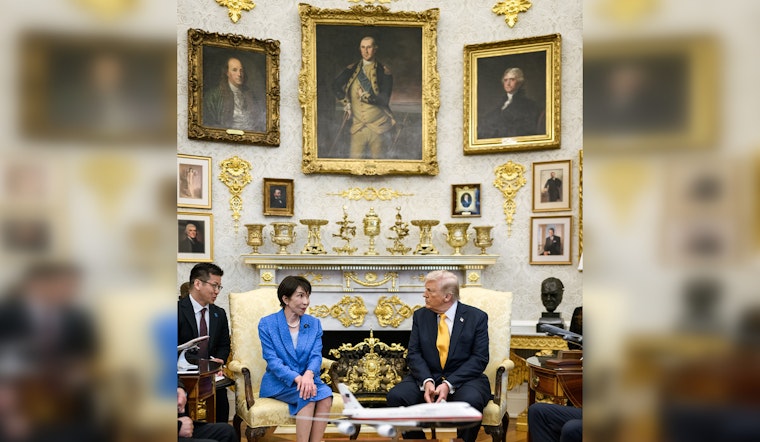
Japan's prime minister, Sanae Takaichi, is in Washington this week for a three-day high-stakes visit with President Donald Trump, arriving just as U.S. and Israeli strikes on Iran that began on Feb. 28, 2026 continue to scramble global security priorities. Tokyo is pushing for deeper cooperation on regional defense, critical minerals and energy, while also hunting for concrete trade and investment wins. The timing is tricky for the alliance: Japan needs to prove its value to Washington without getting pulled directly into combat operations overseas.
On Wednesday, Takaichi told reporters that "we must work toward restoring peace and stability in the Middle East," and she warned in parliament that the U.S. visit "will be a very difficult one" that she intends to use to maximize Japan's national interest. As The Baltimore Sun notes, her agenda blends hard security asks with industrial and trade pitches aimed squarely at coming home with tangible deliverables. Japanese officials have also acknowledged that some U.S. forces based in Japan are being shifted to the Middle East, a redeployment that adds extra urgency to every meeting on this trip.
Big money, big leverage
One of Tokyo's biggest pressure points is money, and a lot of it. In mid February, Japan announced a roughly $36 billion first tranche of Japan-backed projects in the United States as part of a larger $550 billion investment pledge. According to Yonhap, U.S. officials said that initial package includes a 9.2-gigawatt natural-gas plant in Ohio, a Gulf Coast crude export terminal in Texas and a synthetic industrial-diamond plant in Georgia. Japanese ministers are betting that these splashy investments will help lock in energy and critical-mineral supply chains at a time when trade tensions and tariffs remain politically explosive.
Security and minerals
Security issues sit at the core of the visit. Tokyo is weighing deeper cooperation on missile defenses as Washington advances its "Golden Dome" multi-layer concept, a possibility highlighted in reporting that cited coverage by Japan's Nikkei. International dispatches relaying that reporting have been collected by outlets such as TASS. At the same time, Takaichi intends to push for U.S. involvement in developing rare-earth deposits around the remote Minamitorishima atoll, a move described by Nippon.com as central to Japan's broader drive for mineral security.
Policy shifts at home
To back up those ambitions, Tokyo is preparing to shift long-standing policies at home, including plans to relax strict limits on lethal arms exports and to speed up deployments that officials insist are defensive in nature. An AP dispatch carried by The Baltimore Sun reported that the government intends to scrap a ban on lethal arms exports "in the coming weeks" to strengthen Japan's defense industry, while also debating the scope of missions Japanese forces might take on once current hostilities end. Lawmakers and analysts in Tokyo say the moves are calibrated to bolster deterrence without crossing the line into offensive operations abroad.
All of that will be tested in Washington, where U.S. attention and resources are already stretched by the campaign against Iran that began with the Feb. 28 strikes and has reshaped deployments and diplomatic calendars alike. Coverage by PBS NewsHour underscores how the Iran campaign is forcing allies to reorder priorities, complicating Tokyo's effort to keep the summit anchored on the Indo-Pacific. For both capitals, the looming question is whether this visit can turn lofty pledges into durable security arrangements and industrial deals, or whether the widening war will demand tougher, politically risky choices neither side really wants to face right now.


