

























































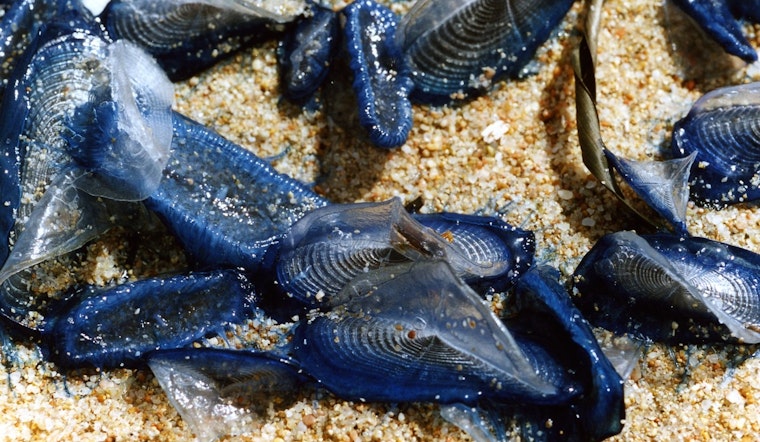
Tiny, bright-blue blobs are piling up along Oregon beaches this week, collecting in thick windrows from Arcadia Beach and Neskowin down to Lincoln City and beyond. The clusters of sail-topped animals, Velella velella, have turned stretches of sand a patchy blue and sparked dozens of photos and social posts from surprised beachgoers. They are harmless to most people, but when they wash up in big numbers they can smell and make crossing the high-tide line a lot less pleasant.
What Are Velella?
Velella velella are colonial hydrozoans, closer relatives of corals and sea anemones than true jellyfish, with a tiny triangular sail that leaves each float at the mercy of surface winds, according to Point Reyes National Seashore. Their delicate tentacles carry stinging cells used to capture zooplankton, and individual floats typically measure from a few millimeters up to several centimeters, roughly 2 to 3 inches, per the Aquarium of the Pacific.
Why Are So Many Washing Ashore?
Researchers say wind patterns and recent ocean conditions are doing the heavy lifting here. A University of Washington analysis of 23,265 COASST surveys found that large Velella strandings typically hit from mid March to mid April and were more common after winters that were warmer than usual, with major events logged from 2003 to 2005 and again from 2015 to 2019, as reported by the University of Washington. Julia Parrish, COASST's director, told the university the data suggest "in a warming world, we're going to have more of these organisms."
How Long Will They Linger?
How long the blue carpets stick around depends on local weather and surf. Sun and onshore wind can dry and scatter the flotillas in just a few days, while cool, damp conditions or fresh waves delivering new rafts can keep beaches blue for longer. Oregon Sea Grant notes that the animals dry quickly to a brittle, chip-like texture and advises avoiding barefoot walks through fresh strandings and not touching your eyes or mouth after handling them, to cut down the chance of irritation. Those precautions match the routine guidance coastal resource managers give whenever mass strandings show up.
Where They Turned Up and What Locals Saw
Reporting and images compiled by The Oregonian/OregonLive show strandings at Arcadia Beach, Neskowin, Winema beaches, Lincoln City and as far north as Washington's Long Beach Peninsula. Beachgoers told the outlet they were struck by how dense some patches were; one person at the Oysterville beach approach said they had "never seen as many," a reminder of how a few offshore rafts can turn into a nearly continuous line onshore when the winds cooperate.
Scientists describe these events as natural and usually short lived, and the COASST citizen-science program encourages volunteers to document unusual strandings to help researchers track how often they happen and how big they get; see COASST for reporting resources. In the meantime, the advice is to enjoy the rare sight from a respectful distance, keep children and pets from sampling the blue blobs and wash hands after contact, in line with Oregon Sea Grant's beach-safety guidance.





