

























































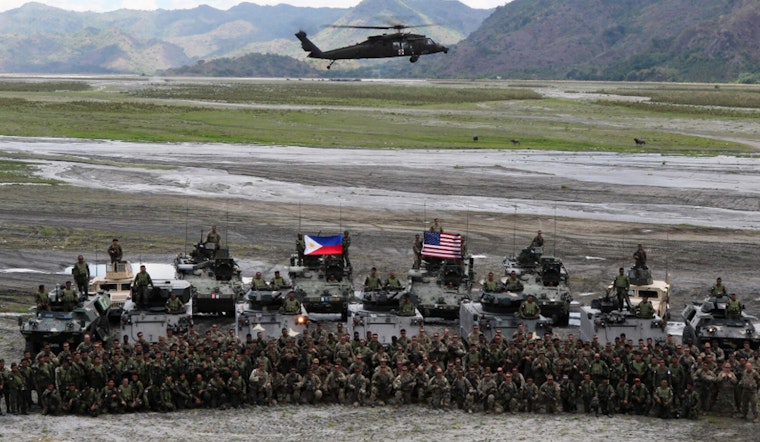
The United States and its allies kicked off the 41st Balikatan joint exercises with the Philippines on Monday, unleashing thousands of troops into live-fire drills and mock battles scattered across the archipelago. The maneuvers formally opened at Camp Aguinaldo in Quezon City and are set to run for roughly three weeks, with events staged in provinces that look straight out toward the disputed South China Sea and the Taiwan Strait. American officials say about 10,000 U.S. service members are among more than 17,000 participants in this year’s exercise, a scale that signals Washington’s determination to reassure Indo-Pacific partners even while it juggles conflicts elsewhere.
Opening At Camp Aguinaldo
The launch ceremony at Camp Aguinaldo brought together top Philippine and U.S. commanders and doubled as a very public pledge of ongoing security cooperation. Lt. Gen. Christian Wortman told attendees that “the United States focus on the Indo‑Pacific and our ironclad commitment to the Philippines remains unwavering,” as reported by San Francisco Chronicle. Philippine Chief of Staff Gen. Romeo Brawner cast the drills as a way to boost deterrence and resilience in the face of potential aggression. The opening drew military delegations from several partner countries and heavy local coverage in Manila, a reminder that these war games are as much political theater as they are training.
Scale And Scope Of The Exercises
According to U.S. Indo‑Pacific Command, Balikatan 2026 runs from April 20 to May 8 and will train more than 17,000 personnel from the Philippines, the United States and partner nations, with activities spread across Luzon, the Visayas and Mindanao. The official release describes a program that spans air, land, sea, space and cyber domains and leans heavily on command-and-control and combined logistics rehearsals. Organizers also point to humanitarian‑civic assistance projects meant to strengthen local disaster response capabilities. The drills are framed as part of the 75th‑anniversary commemoration of the U.S.‑Philippine Mutual Defense Treaty and as an effort to speed up the modernization of Armed Forces of the Philippines units.
Live-Fire Drills And New Capabilities
Philippine spokespeople say this year’s exercise will feature a headline-grabbing sea‑strike sequence. Japan is slated to fire coastal missiles from Ilocos Norte to help sink a mock enemy ship about 40 kilometers offshore, while U.S. forces plan to employ a marine drone packed with explosives to further bombard the target. Those operational details, along with the U.S. troop figure, were laid out to reporters by Philippine and American officers, as reported by The Associated Press. Philippine officials emphasize that the capstone strikes are carefully scripted events designed to test coordination and safety protocols, not trigger real conflict. Troops will also rehearse integrated air‑and‑missile defense, counter‑landing live fires and maritime sustainment operations.
Expanded Allied Participation
What started as a bilateral drill has turned into a wider show of allied muscle. Forces from Japan, France, Canada, Australia and New Zealand are joining Philippine and U.S. units, and organizers have invited international observers from more than a dozen other countries. Participating militaries are bringing a mix of ships, aircraft, missile systems and support teams to test how well they can operate together in contested maritime environments. Japan has been slated to contribute surface, air and missile assets under recent reciprocal access arrangements with Manila. Officials with U.S. Indo‑Pacific Command say the expanded lineup is meant to highlight allied resolve to maintain a free and open Indo‑Pacific.
Shifting Logistics And U.S. Posture
Behind the high‑profile live fires, U.S. planners are quietly reworking how they move fuel, ammo and gear around the islands. Ahead of Balikatan, they have put a spotlight on distributed maritime logistics, offloading equipment through austere ports and even civilian barges to widen resupply options and cut vulnerability in contested waterways. Those rehearsals, documented through Pentagon imagery and military briefings, are intended to create more resilient supply chains across the archipelago in case of crisis, according to reporting by USNI News. U.S. officials say the deployment is meant to reassure allies even as American policy attention is pulled by other overseas commitments in the Middle East.
Local Concerns And Pushback
On the home front, not everyone is cheering the war games. Fisherfolk groups and other civic organizations have pushed authorities to disclose how much is being spent on the drills and have warned of potential economic and environmental costs to coastal communities, according to BusinessWorld. Beijing has also objected, arguing that joint exercises like Balikatan risk containing China’s rise, a critique reported by international outlets covering the opening events. For Washington and Manila, officials are presenting the drills simultaneously as a deterrent and as a large‑scale rehearsal for disaster response, even as regional tensions remain stubbornly high.




