

























































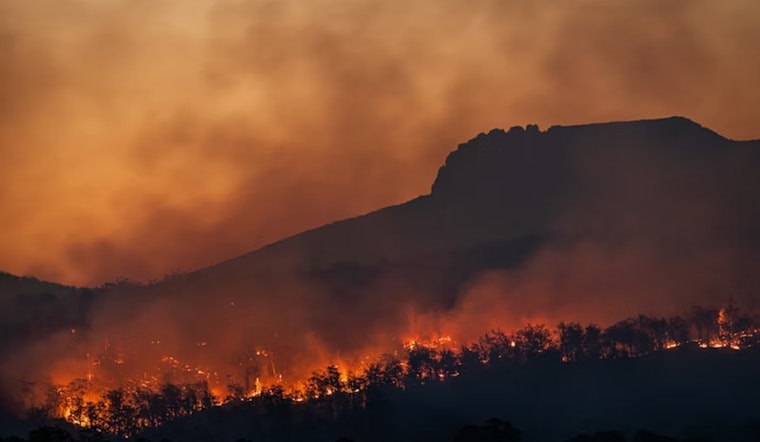
A new continent-wide study says the nightly break firefighters have long counted on is fading, and the Bay Area is very much part of the story. Flames that used to go to sleep after sunset are now burning later into the night and flaring back up earlier in the morning. That means more smoke hanging around, trickier evacuations in the dark, and crews stretched across a longer, more exhausting workday.
According to The Associated Press, researchers publishing in the journal Science Advances found that the number of hours across North America when weather is favorable for wildfires has risen roughly 36% compared with about 50 years ago. The AP report says the study estimated that California now sees about 550 extra potential burning hours per year compared with the mid-1970s, while parts of the Southwest saw increases up to about 2,000 hours annually.
Nighttime burning is an emerging pattern
The new analysis builds on earlier work that tied drought to stubborn overnight fire activity. A 2024 study in Nature examined the hourly cycle of 23,557 fires and identified more than 1,000 overnight burning events. It concluded that drought-preconditioned fuels were a major driver of fires that did not “go to sleep” at night.
How researchers reconstructed five decades of risk
Reporters say the Science Advances team used hour-by-hour satellite weather data for nearly 9,000 larger blazes from 2017 through 2023, then trained a machine-learning model to estimate how often conditions would have been favorable for burning going back to 1975. That hindcasting approach produced the continent-wide potential burning hours estimates now circulating in coverage, according to reporting by The Washington Post.
Why nights matter, and why it is getting harder
“Fires normally slow down during the night, or they just stop,” study co-author Xianli Wang told reporters, “but under extreme fire hazard conditions, fire actually burns through the night or later into the night.” That lost overnight lull gives fires a running start the next day and can make containment much tougher, firefighters and outside scientists told The Associated Press.
How agencies are adapting
Fire managers in Canada and some U.S. regions are already tweaking playbooks to match the longer burn window. Agencies have been adding night-capable aircraft, training more pilots for after-dark operations, and reworking staffing and dispatch systems so crews are ready later into the evening. Coverage republished from the Canadian Press notes that Alberta and British Columbia have expanded nighttime aerial capability in recent seasons to better track and contain fires after dark, as reported by the Lethbridge Herald / Canadian Press.
What Bay Area residents should do now
Longer stretches of fire-friendly weather translate into more smoke days and seasons that drag on. For Bay Area residents, that means treating wildfire readiness as a year-round chore, not a once-a-summer checklist. Officials continue to urge people to maintain defensible space, review evacuation plans, and keep tabs on air quality and smoke through state and federal tools like SmokeReady California and the EPA’s AirNow fire and smoke map, which offer local alerts and guidance.
The research underscores that climate-driven warming is changing not just how much burns, but when fires burn, with direct consequences for how communities prepare. For more reporting on the Science Advances analysis, see coverage in the Eagle-Tribune and the earlier Nature study linked above.




