

























































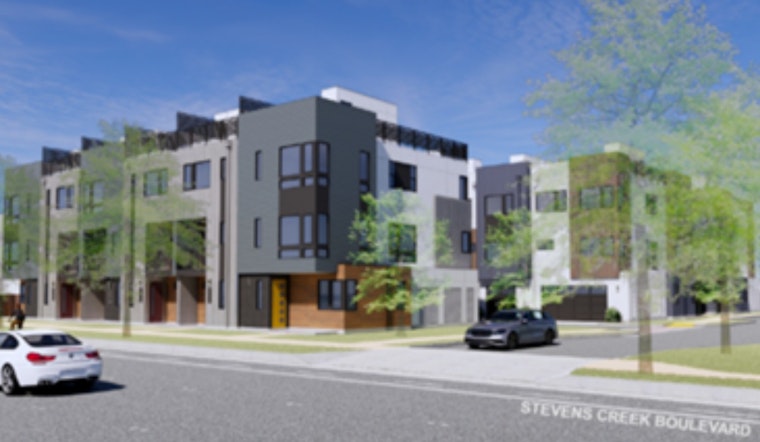
Cupertino is clearing the way for more townhomes along Stevens Creek Boulevard, signing off on a small but closely watched project a short walk from the former Vallco mall.
This winter, the City Council voted 4-0, with one abstention, to approve Dividend Homes' plan for 32 townhouse-style units on a 1.77-acre mid-block site on Stevens Creek Boulevard. The development will replace three low-rise office buildings with three-story homes that top out at about 45 feet. Six of the units are reserved for moderate-income buyers, with the remaining 26 sold at market rate.
According to the City of Cupertino, the project, listed as “20045 & 20065 SCB/Dividend Homes II,” was submitted under Senate Bill 330, the state’s housing streamlining law. It won a planning commission recommendation before receiving final council approval earlier this year.
The administrative record shows plans for 32 three-story townhomes on the 1.77-acre lot, with units running roughly 1,548 to 2,156 square feet and a maximum height near 45 feet, according to CEQAnet. Dividend Homes requested density-bonus concessions to climb past some local zoning limits in exchange for including the six moderate-income homes.
State Standoff Over the 90-Day Clock
The approval lands in the middle of a simmering fight between Cupertino and Sacramento over how long cities must give developers to respond when an application is deemed incomplete.
The Real Deal reported that in 2025, the California Department of Housing and Community Development told Cupertino the 90-day response window under the Permit Streamlining Act resets every time the city issues an incompleteness letter. State officials say that interpretation protects developers’ vesting rights.
Pro-housing advocates and developers did not buy the city’s narrower reading. They sued Cupertino in April 2025, arguing the city’s approach effectively stripped projects of builder’s-remedy protections, according to YIMBY Law.
What It Means for Cupertino’s Housing Targets
All of this plays out against Cupertino’s ambitious state housing quota. For the 2023-2031 housing element cycle, the city is assigned a Regional Housing Needs Allocation of 4,588 units, with local plans calling for a buffer on top of that number, per city planning documents.
As approvals stack up along Stevens Creek Boulevard, observers are asking how much impact a string of relatively small townhome projects will really have. Local reporting has noted that this kind of for-sale “middle” housing helps, but may not deliver the income diversity or unit volume the state is looking for, as reported by San José Spotlight. Planners and advocates say the bigger test is whether projects that lean on state streamlining tools can meaningfully close Cupertino’s RHNA gap.
What Comes Next on Stevens Creek
Dividend Homes has not publicly shared a construction schedule or cost estimate for the townhomes. The Real Deal reported that neither timeline nor budget details were released alongside the council approvals.
With entitlements in hand, the project will move into building permits and technical plan checks. Neighbors who raised privacy worries and questioned rooftop-deck designs during public hearings are expected to keep a close eye on design review and any tweaks that show up in later phases.
Developers across Cupertino will also be watching the ongoing fight over the 90-day rules. Any new guidance or court decision in the HCD-city dispute could shape how quickly similar projects secure vesting and move forward.
Legal Stakes for Cupertino
The Department of Housing and Community Development’s position that the 90-day clock resets with each incompleteness letter has already led to formal notices and lawsuits, and reporting warns it could bring enforcement actions if courts or regulators ultimately back the state’s view.
For now, the conflict is tied up in administrative and legal proceedings. Pro-housing groups are pressing their claims while Cupertino continues to defend its interpretation of the law, according to YIMBY Law.





