

























































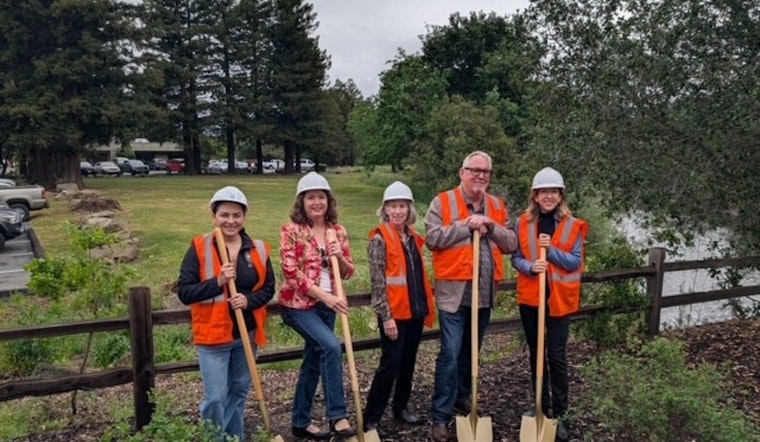
Downtown Napa’s riverfront is officially under the shovel again, as crews move into the next big chapter of a flood project that has been decades in the making.
Yesterday, officials from the Napa County Flood Control and Water Conservation District and the U.S. Army Corps of Engineers broke ground on the latest phase of the Napa River/Napa Creek Flood Protection Project. The ceremony marked the start of construction on the first floodwall segment north of the Napa River bypass and launched work that county leaders say will raise protection to the 100-year level while adding new riverfront trails and restoring riverbank habitat. It is the long-discussed “living river” plan finally shifting from the drawing board to fresh concrete along the downtown Napa river corridor.
Speakers at the event included Richard “Rick” Thomasser, Napa County’s deputy director of public works; Scott Sedgley, chair of the Flood Control District; Col. Robert M. McTighe of the U.S. Army Corps’ Sacramento District; and Rep. Mike Thompson, according to a post on X from the County of Napa.
The Napa County Flood Control and Water Conservation District & U.S. Army Corps of Engineers, broke ground today on a significant new phase of the Napa River/Napa Creek Flood Protection Project.
— County of Napa (@CountyofNapa) April 1, 2026
Learn more: https://t.co/ufyS5bHnGk pic.twitter.com/Eo6UY1EOfQ
The district and the Corps have a written agreement that secures roughly $48.3 million in federal funding for construction of the remaining floodwalls, with the district managing the on-the-ground work and seeking federal reimbursement as segments are completed, according to county filings. Contract and funding details are laid out in Napa County Legistar.
What the work will look like
This phase calls for new concrete and sheet-pile floodwalls north of the existing bypass and additional walls running from the Hatt building down toward Imola Avenue, with each floodwall reach totaling roughly a mile along the west bank. Plans also fold in riverbank restoration, scour protection beneath Lincoln Avenue, and an extension of the Napa River Trail from the River Terrace Inn north to Lincoln Avenue. A lighted pedestrian crossing at Lincoln Avenue is slated to knit those trail segments together, according to the U.S. Army Corps Sacramento District.
Mapping, flood insurance and community impact
The work is designed to deliver 100-year flood protection for large sections of downtown Napa using the living-river approach that has guided the project from the start. If the improvements are built and certified to federal standards, they could trigger FEMA map revisions that reshape which properties fall inside the Special Flood Hazard Area. County staff have said they expect the project to lead to remapping that could remove many properties from mandatory flood insurance requirements, and residents can find background on mapping and the Letter of Map Revision process on the Napa County FEMA information.
Property and permitting
District records show the Floodwalls North of the Bypass contract requires acquiring property interests, including partial fee and easement rights, around Lincoln Avenue and nearby parcels to make room for the wall alignments. Napa County staff told the board that those interests must be secured before contracts can be awarded and that the board may move to initiate eminent-domain proceedings if negotiations with property owners do not produce timely agreements, as detailed in Napa County Legistar.
Schedule and next steps
The groundbreaking marks the official start of construction on the first segment, the floodwalls north of the bypass, with the district aiming to award and mobilize the contract in the coming months, according to the district’s schedule in project documents. Design and construction for the remaining increments are staged across multiple years in the Final Subsequent Environmental Impact Report and related Corps materials, with environmental review, permitting and phased construction expected to continue through the mid-to-late 2020s (Final Subsequent EIR).
This phase wraps up some of the last large pieces of a decades-long living-river program that has already rebuilt terraces, replaced bridges and added promenades along the Napa River. Officials say the new work will further cut flood risk for homes and businesses while stitching together a more continuous riverwalk, restoring habitat and, if mapping changes follow, easing flood insurance burdens for some downtown property owners (Napa County Flood Project).


