

























































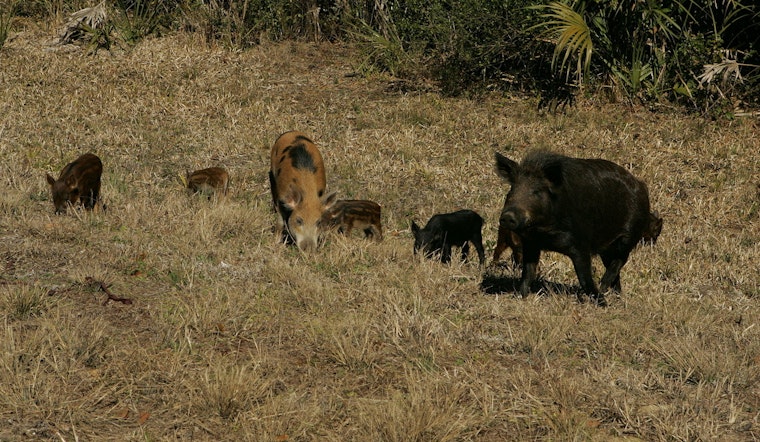
Trail camera footage has captured a full sounder of feral hogs rooting through the brush along Salado Creek near the Frost Bank Center, an unsettling reminder that wild pigs are increasingly popping up inside San Antonio’s greenways and right up against neighborhood edges. The short clip shows several dark-coated adults weaving through thick riparian vegetation and wandering close to paved trails that walkers and cyclists use every day. Neighbors say sightings like this have become noticeably more common in recent seasons as the animals push deeper into developed areas.
The footage, published April 9, 2026, by local station KENS5, shows the hogs near both Salado Creek and the Frost Bank Center. The station reports the clip came from a trail camera and includes shots of the pigs rooting in mud and moving along the creek’s floodplain. Once the video hit neighborhood message boards, it quickly stirred up fresh questions about who is actually managing these animals and what, exactly, residents are supposed to do when they run into them.
Statewide surge and why it matters
Texas’ wild pig numbers are now measured in the millions, and that scale is no small problem for farms, parks and waterways. Texas A&M AgriLife has pointed to an estimated statewide population of about 2.6 million, while the Texas A&M Natural Resources Institute has published pieces placing the number closer to 3 million and detailing the rising cost of damage and control efforts. According to those agencies, feral hogs tear up yards and wetlands, spread parasites and generally make it harder to keep urban green space both usable and safe.
Salado Creek and local hotspots
Salado Creek is no stranger to hog trouble. Officials told MySA that a feral hog was reported near Covington County Park along the Salado Creek Greenway in mid-2023. Local reporting has flagged similar incidents in other nearby parks and along neighborhood edges, where animals follow watercourses and green corridors right into developed blocks. Often, residents and park crews spot the damage first: wallows, rooted-up turf and fresh tracks show up before anyone actually catches the hogs in the act.
What officials and neighbors are doing
In response, city and county agencies have leaned on a mix of professional trappers, rotating mobile traps and public-education campaigns to keep hogs out of parks. Local coverage has chronicled those efforts around Friedrich Wilderness Park and other trouble spots. In one example, hog wild in Stonewall Estates coverage noted that San Antonio approved a trapping contract meant to fund mobile traps and processing, an approach officials say is designed to remove whole sounders instead of picking off single animals. In some neighborhoods, wildlife-management committees are forming to coordinate reports and, when necessary, hire trained trappers to deal with persistent hog activity.
How to stay safe and what to report
Wildlife experts and local officials have a fairly simple playbook for residents: do not approach or try to feed feral hogs, secure trash and pet food, keep dogs leashed, and document sightings with photos or video only from a safe distance. For disease and biosecurity concerns, federal wildlife specialists note that feral swine can carry a variety of parasites and pathogens, and they advise reporting any sick or dead animals to federal wildlife services. The USDA-APHIS feral swine resource center lists reporting tools and management guidance for the public and land managers. If a hog turns up in a San Antonio city park or on public trails, officials say residents should call 311 so Parks and Animal Care Services can respond.
The trail camera clip from Salado Creek is the latest reminder that Texas’ feral hog problem is no longer just a rural headache; it is now a neighborhood one. Residents who spot hogs are urged to report what they see, avoid direct contact and share any video or photos with city officials and wildlife experts so entire sounders can be tracked and managed as safely as possible.





.jpg)