

























































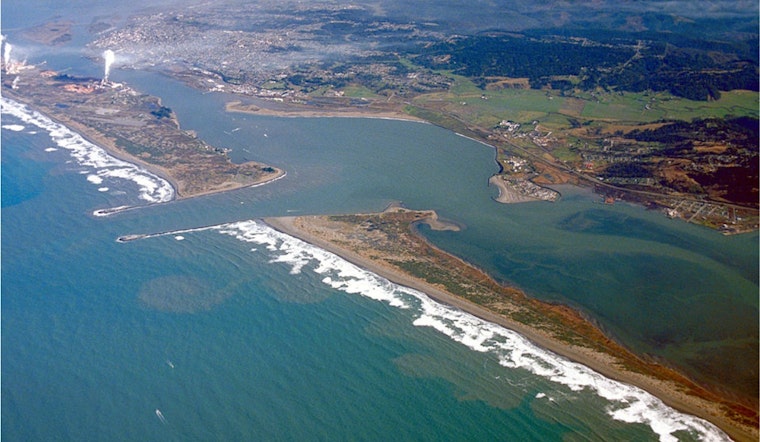
Humboldt Bay is being lined up for a starring role in California’s clean energy future, as the state moves to turn the harbor into a staging and assembly hub for floating offshore wind. The concept is massive: hundreds of giant turbines in federal waters and a major industrial buildout on parts of the Samoa Peninsula. Making it work would require heavy-lift port facilities, long stretches of undersea and onshore transmission, and multibillion-dollar investment spread over roughly a decade of active construction. Local residents, fishing interests and tribal cultural practitioners are already weighing the promise of jobs and investment against risks to eelgrass, salmon, kelp and other marine habitat.
In a competitive process last year, the California Independent System Operator tapped California Grid Holdings LLC, a unit of Viridon Holdings, as the approved sponsor for two new Humboldt 500-kV transmission projects, according to California ISO. A February 2026 analysis by the Schatz Energy Research Center estimates that together the projects carry lifetime transmission revenue requirements of about $5.18 billion, with a capital cost cap of roughly $1.7 billion, figures intended to protect ratepayers while still underwriting the new grid connections.
The scale is hard to overstate. State planning documents describe turbines staged onshore and then towed roughly 20 to 60 miles offshore, with assembled platforms and blades reaching heights that industry coverage likens to very tall skyscrapers. Reporting on the state strategic plan notes that the floating machines would be unlike almost any commercial wind farm built so far, because the Pacific drops off steeply here and the equipment will operate in deeper water and farther from shore. That distance and depth, combined with the need for export cable routes and new substations, help explain why planners talk about hundreds of miles of new transmission and years of work to plug the North Coast into California’s grid.
What It Would Mean For Samoa And The Bay
The Harbor District is pitching a heavy-lift terminal at Redwood Marine Terminal I to stage, assemble and launch the floating systems, and the district’s planning materials spell out wharf, crane and laydown space needs for an operation of that size. In 2025 the federal Transportation Department pulled roughly $427 million in grant funding that had been earmarked for port upgrades, a move that local coverage says forced planners to scramble for replacement funding and raised pointed questions about the project’s near-term finance plan. District officials and local advocates say they intend to keep pushing ahead on permitting and design while pursuing state grants and private partners to get the terminal shovel-ready.
Local Reaction And Environmental Concerns
On the ground, reactions run the gamut from cautious optimism about job creation to sharp worries about dredging, vessel traffic and damage to culturally important places and marine life. Tribal cultural practitioners and environmental advocates have warned that heavy construction and increased ship movements could harm salmon runs, whales, abalone and eelgrass beds, while other tribal governments have emphasized the potential for co-management and local economic benefit. Public meetings and community workshops have become regular events as agencies and researchers try to navigate competing priorities.
Who’s Paying And The Timeline
The state has put offshore wind at the center of its long-term clean energy strategy and set aside planning and grant programs to ready ports and workforce pipelines. Even so, heavy-lift terminals, undersea cables and new 500-kV lines will depend on a mix of public and private money. Current planning documents and sponsor timelines envision the Humboldt transmission projects coming online in the 2030s, with active assembly and installation at terminals stretching across roughly a decade once major permits and funding are locked in. The Harbor District has started the CEQA permitting process for the Heavy Lift Terminal and has posted scoping and draft materials as the next step in environmental review.
Bottom Line
If it moves forward as advertised, the Humboldt plan would rank among the boldest floating wind experiments in the world. It holds out the prospect of jobs and clean power, but it also comes with habitat, cultural and fiscal trade-offs that will be argued over in public hearings, environmental review and state and federal permitting for years to come. Expect continued debate over who pays, how impacts are reduced or repaired, and whether this corner of the North Coast ultimately becomes a national hub for floating offshore wind or a cautionary tale about how hard that transition can be.





