

























































National City’s mayor is throwing up a big red stop sign in front of the Port of San Diego’s plan for a massive electric truck charging yard on Tidelands Avenue, warning the project’s location and battery load could put his city on the hook for major safety and infrastructure risks.
Mayor Ron Morrison says the idea of dozens of battery‑heavy big rigs rolling through town, plus a large onsite energy storage system, would magnify the fallout from any serious accident and could force costly upgrades for the city’s fire and public‑works departments. Port officials counter that the project cleared its draft environmental review with no major impacts flagged, and say they are continuing to refine designs and permits with developer Skycharger.
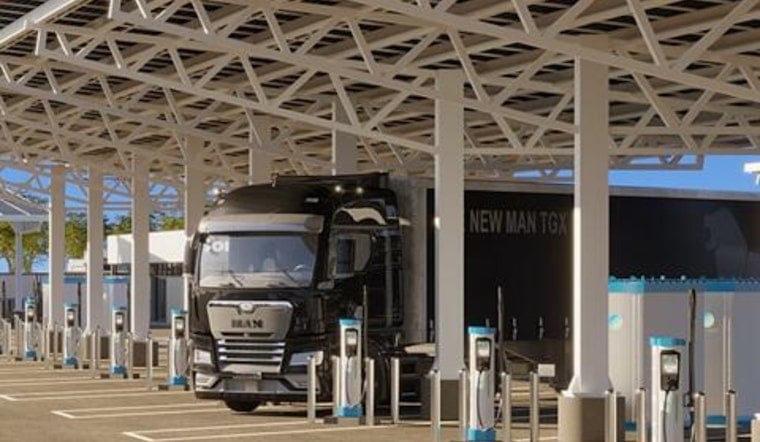
The Port selected Skycharger to develop the roughly 4.8‑acre site at 19th Street and Tidelands Avenue. The project description calls for 70 charging ports, a 1,750‑kW solar canopy, a 2.5 MW / 5 MWh battery energy storage system, a convenience store and public green space, according to the Port of San Diego. The Port also outlines a Trucking as a Service program meant to help owner‑operators lease, charge and maintain electric trucks through a subscription model. Officials say the draft environmental impact report was released for public review from Jan. 29 to Mar. 16, and that staff are now sorting through comments to prepare a final version for decision makers.
Mayor warns of fire risk and heavier trucks
Morrison has been blunt about his discomfort with the pace and scope of the proposal, telling reporters it feels rushed and that the draft review plays down local dangers. An “18‑wheeler is basically a large mobile lithium power bank,” he said, urging officials to restart the process, as reported by 10News. He also argues that the added battery weight will chew up local roads faster and require new equipment and training for the fire department.
City leaders, including the fire chief, have echoed those concerns at recent public meetings, pressing for more technical detail on worst‑case scenarios, firefighting tactics and emergency access before any approvals move ahead.
Draft EIR includes hazard and emergency plans
The draft environmental report and its appendices include a hazard‑mitigation analysis and an emergency‑response plan that spell out fire‑safety measures, access controls and coordination steps with National City emergency services, according to filings on the state CEQA portal. The CEQA docket also contains technical memos on air quality, noise, mobility and hazard mitigation, and shows the Port accepted public comment during the official review period.
Those documents underpin the Port’s conclusion that the project would have no significant impacts on air quality, traffic, noise or public safety, at least under state environmental law standards. In other words, on paper the hub clears the bar, even as political and neighborhood questions pile up.
Board vote, permits and public outreach ahead
Port staff say they are preparing responses to public comments and intend to bring the final EIR, a Coastal Development Permit and a draft lease to the Board of Port Commissioners at a future public hearing, so commissioners can decide whether to approve the project, as reported by 10News. That vote will effectively determine whether this remains a concept or becomes a construction site.
In the meantime, Port and Skycharger staff are working the neighborhood. They have been meeting with stakeholders in National City, and the Port plans a booth at the April 4 Pepper Park reopening to gather feedback from residents and truck drivers. If commissioners ultimately certify the EIR and grant permits, the Port estimates construction would take roughly six months.
Why the Port and developer say the hub matters
The Port is pitching the hub as a cornerstone of its Maritime Clean Air Strategy, highlighting earlier electrification projects, like all‑electric mobile harbor cranes and shore‑power hookups for ships, as part of a broader effort to cut diesel pollution, according to the Port of San Diego. If it works as envisioned, the Tidelands site would help truckers plug in where they now fill up.
Skycharger, which has received state grant funding for other heavy‑duty charging projects, says the National City hub would also include workforce and community benefits linked to its Trucking as a Service model, according to a company release cited by PR Newswire. The idea is to bundle the truck, the charging and the maintenance in a way that makes it easier for small operators to switch from diesel to electric.
For now, the fight in National City captures a familiar port‑side tension: whether the clear health gains from slashing diesel emissions outweigh the new risks and infrastructure burdens that come with large batteries and high‑capacity power systems. Expect the debate to continue in public forums as National City officials and port commissioners work through the final EIR responses and gear up for a high‑stakes vote.





