

























































The U.S. Court of Appeals for the Seventh Circuit has signed off on a lifetime gun ban for a former Wisconsin drug dealer, ruling that federal law can permanently disarm him because of his record. The decision, handed down Thursday, leaves Edlando Watson’s gun conviction in place and hands prosecutors a win on their argument that drug trafficking qualifies as a "dangerous" offense under the Constitution.
Midnight chaos, an Uber escape and a trail of evidence
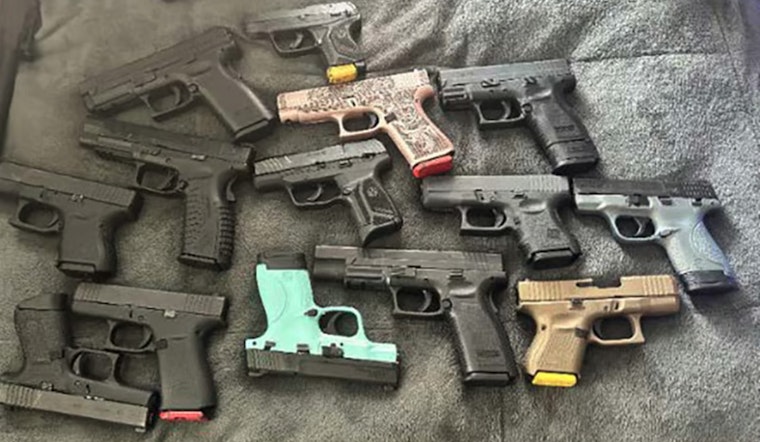
The case stems from a chaotic night in May 2022 in Madison, Wisconsin, when a woman bolted from a residence, jumped into an Uber and yelled, "He’s coming with a gun!" as three shots rang out, according to court records. Investigators later linked a suspect phone number to a man who went by "Meek," dug through storage units, reviewed jailhouse calls and ultimately recovered several handguns and rifles that the government says carried DNA matching Watson.
Those details appear in the court filings and in reporting by Courthouse News.
What the Seventh Circuit decided
Chief Judge Michael Brian Brennan, writing for a three-judge panel, rejected Watson’s claim that the federal felon-in-possession law violates the Second Amendment as applied to him. In the opinion, Brennan wrote that "his disarmament is consistent with the history and tradition of Founding-era laws."
The panel concluded that drug trafficking is inherently dangerous conduct and fits within the historical analogues courts now look to under the Bruen framework. The Seventh Circuit’s opinion is posted on the court’s website, and the appeal appears on the federal docket as USA v. Edlando Watson, No. 24-2432, on Justia.
A deliberately narrow ruling
The judges were careful to say what they were not deciding. The panel specifically declined to answer whether people convicted of non-dangerous felonies, such as many white-collar or low-level offenses, can also be permanently stripped of gun rights.
The court also turned aside Watson’s challenge to the seizure of his DNA. It found that federal agents had an independent basis to obtain the warrant, regardless of earlier actions by state police. As reported by Tampa Free Press, the opinion leaves open a narrower path for prosecutors focused on defendants the panel was willing to label dangerous.
Bruen, Rahimi and a growing split over felon gun bans
The decision lands in the middle of the post-Bruen legal shakeup, where courts now ask whether modern gun regulations are "consistent with the Nation’s historical tradition of firearm regulation." That test comes from New York State Rifle & Pistol Ass'n v. Bruen, as outlined by the Supreme Court.
The Supreme Court later clarified in United States v. Rahimi that laws disarming people who pose credible threats can survive that history-and-tradition test, again in an opinion available from the Supreme Court. But federal appeals courts are still openly disagreeing about how far that principle goes, especially when it comes to 18 U.S.C. § 922(g)(1), the core felon-in-possession statute.
The most visible outlier so far is the Third Circuit’s en banc decision in Range v. Attorney General, where that court held that the statute was unconstitutional as applied to a man with a nonviolent record, as reflected on Justia. Against that backdrop, the Seventh Circuit’s new ruling adds a clear appellate holding that drug trafficking falls into the category of dangerous conduct that can justify a lifetime gun ban under the historical-tradition approach.
For prosecutors and defense lawyers in Wisconsin, the opinion draws a sharper line between people whose past crimes are likely to support permanent disarmament and those whose records are less likely to clear that bar. The appeal is cataloged as No. 24-2432 on the federal docket at Justia.





