

























































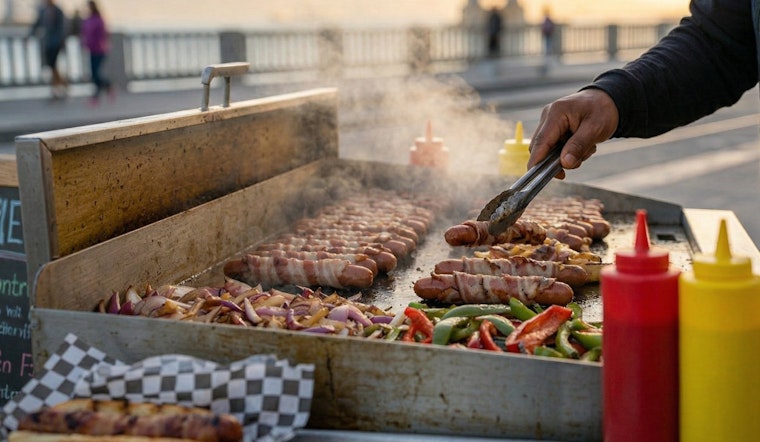
The tamales are still warm, the mangoes are still fresh, and the vendors who've been feeding the Mission District for years are still showing up — but after the San Francisco Board of Supervisors unanimously approved a sweeping new street food ordinance on March 24, the question on every vendor's mind is: for how long? The law now heads to a second and final reading on April 7, after which Mayor Daniel Lurie will have ten days to sign it into law.
At the heart of the controversy is a new regulatory category — the "Compact Mobile Food Operation," or CMFO — created to bring San Francisco's local codes into alignment with California's SB 972, a 2022 state law signed by Governor Newsom that decriminalized street food vending statewide and took effect January 1, 2023, as reported by Mission Local. The state law required cities to draft their own permitting frameworks in response — and San Francisco's version, three years in the making, is now drawing fierce opposition from the very vendors it was ostensibly designed to legalize.
The Price of Compliance
The new ordinance requires street vendors selling fresh, hot, or unpackaged food to operate from compliant carts — not tables — equipped with handwashing stations and refrigeration. Those carts can run anywhere from $8,000 to $18,000, according to ABC7 and El Tecolote. For vendors netting roughly $2,000 a month, that's not a compliance cost — it's a business-ending one.
On top of the equipment burden, vendors are no longer permitted to prepare food at home. Instead, they must rent time at licensed commissary kitchens, which, as Nuestra Causa director Leila Ovando noted to ABC7, run $30 to $100 an hour. If a vendor is already clearing just $2,000 a month in profit, commissary kitchen fees alone could consume a substantial chunk of that income. "That eats substantial cost for folks," Ovando said. The nonprofit Nuestra Causa represents approximately 75 food vendors in the Mission District.
Vendor Andrea Guirola put it plainly after the vote, telling Mission Local that vendors are "really scared" and feel they're "being asked to come up with money we don't have." At a Board of Supervisors hearing earlier this year, vendor committee leader Andrea told supervisors in Spanish that without parallel support, the law amounted to "economic destruction" — adding that rent, expenses, and enforcement don't pause for bureaucratic timelines.
The MEHKO Gap
What's rankled vendors and advocates most isn't just the cost — it's what San Francisco chose not to include. When other Bay Area counties began enforcing SB 972, most of them simultaneously adopted a parallel program called Microenterprise Home Kitchen Operations, or MEHKO, which allows vendors to legally prepare food in their own homes rather than at commercial commissary kitchens. According to Mission Local, Santa Cruz, Monterey, Santa Clara, Sonoma, Alameda, San Mateo, and Contra Costa counties all adopted MEHKO. San Francisco did not.
The Department of Public Health's Jennifer Callewaert acknowledged at a February committee hearing that MEHKO is "a very large program" requiring staffing and budget analysis, per Local News Matters. But for vendors who testified through translators at City Hall — many of them single mothers and disabled workers — "we're studying it" doesn't pay the rent. Nonprofit SF New Deal, which has disbursed over $57 million to small businesses since 2020, submitted a letter to the Board of Supervisors supporting the CMFO ordinance while explicitly urging the city to advance MEHKO implementation simultaneously. "Without both, we risk creating a compliance gap that puts undue financial pressure on vendors," the organization wrote.
Fee Waivers — A Silver Lining with Caveats
The ordinance isn't without vendor-friendly provisions. An amendment secured in part by District 9 Supervisor Jackie Fielder waives all permit and license fees under the Municipal Code for CMFO operators — meaning vendors won't owe the $188 to $502 in annual fees that might otherwise apply, according to the official SF Gov legislative record. But the fee waiver, while meaningful, doesn't address the underlying capital problem: buying the cart in the first place.
The city's own inspection data underscores why regulators pushed for reform at all. According to ABC7, city data from 311 records found 60 health violations in 88 mobile food vendor inspections conducted in 2025 — violations that included missing handwashing stations and improper food storage. The Department of Public Health frames the ordinance as a health and safety alignment with state code, not a crackdown on the vendors themselves.
What Los Angeles Did Differently
Vendors and advocates have repeatedly pointed to Los Angeles as a counterexample worth studying. After adopting its own post-SB 972 framework, Los Angeles launched a $2.8 million cart program designed to help 280 vendors purchase compliant equipment — essentially recognizing that you can't mandate expensive equipment upgrades without also helping people buy them, as reported by Mission Local. Los Angeles also began rolling out MEHKO in November 2024. San Francisco has done neither yet.
For vendor Marta Regidor, who sells mangoes, tamales, and cut fruit near the 24th Street BART Plaza, the timeline is already pressing. She told El Tecolote she's already in contact with Oakland-based fabricator Emanuel Baca, who builds carts that have passed DPH inspections — but is staring down a financial gap she doesn't know how to bridge. "Where am I going to gather all that money? I don't know what I'm going to do," she said.
Organizing, Advocacy, and What Comes Next
The ordinance's passage hasn't quieted the vendor community — if anything, it's accelerated their organizing. Nuestra Causa has urged Supervisors Connie Chan and Jackie Fielder to introduce a resolution providing vendor support, according to an internal email obtained by El Tecolote. At the February hearings, over a dozen vendors — many speaking through interpreters — described missing income from enforcement sweeps during the Super Bowl, three years without stable work for some, and disabilities that make 8-hour working days impossible without steady street-vending income.
The ordinance also expands the Department of Public Works' authority to regulate and enforce compact mobile food operations — a change that vendors fear will bring stricter enforcement before adequate support infrastructure is in place. As vendor committee leader Edgar Roge told supervisors: "If these [supports] come together or arrive at the same time, the regularization of vendors will disappear immediately. Certainty is now the only way to avoid destruction later." With the second reading set for April 7 and advocacy escalating, the next two weeks could be decisive for whether San Francisco's street food culture survives its own legalization.





