

























































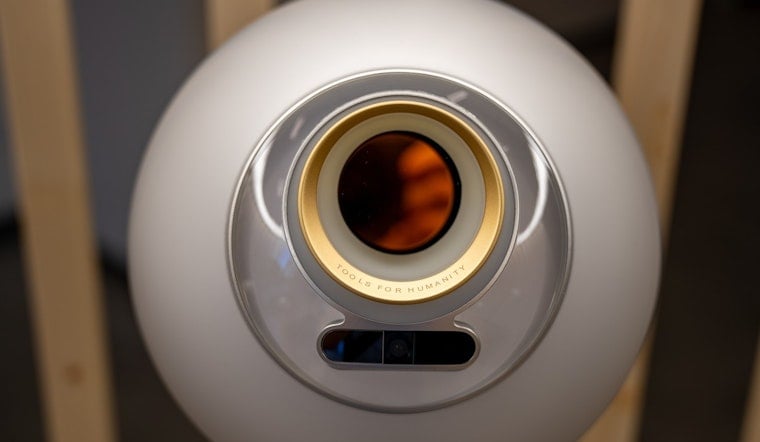
In a city that has grown accustomed to tech billionaires announcing world-changing products over craft cocktails, Sam Altman showed up at The Midway on Friday night to make the case that staring into a glossy white orb is the future of knowing who you're swiping right on. The pitch: Tinder users around the globe can now earn a "verified human" badge on their dating profiles — proof that a real, living person is behind the account — as long as they've already submitted their eyeballs to one of World's iris-scanning Orb devices.
The announcement came at World's "Lift Off" event, held at The Midway, the 40,000-square-foot arts-and-tech venue at 900 Marin St. in the Dogpatch neighborhood. TechCrunch described the gathering as "a packed crowd" eager to hear Altman — who also serves as CEO of OpenAI — make the case for biometric identity verification as the internet's missing layer of trust. Co-founder and CEO Alex Blania was notably absent, reportedly due to a last-minute hand surgery.
Dating in the Age of AI: Prove You're Alive
The Tinder integration, which expands a previously successful pilot program in Japan to global markets, adds a World ID emblem to the profiles of users who have gone through the Orb verification process, according to Wired. As a sweetener, verified Tinder users receive five free "boosts" — a feature that normally costs money and that temporarily amplifies how many users see a given profile by up to ten times. The message to daters is clear: not only are you real, you're also more visible. As Axios noted, Match Group — Tinder's parent company — is formally expanding what had been a limited test to U.S. users.
World's core technology involves an iris scan performed by a physical Orb device. Once scanned, the system generates a unique cryptographic code — a World ID — that proves the holder is a living human without revealing their name, government ID, or other personal data. Wired reports the company frames this as a "private, decentralized" alternative to uploading sensitive documents across the internet. Chief Product Officer Tiago Sada compared the initial public wariness to early skepticism about Apple's Face ID: "Many people used to tape their [sensor] when it came out, then we got used to it."
Beyond Tinder: Zoom, Docusign, Concert Tickets, and AI Agents
The Tinder rollout was far from the only announcement on Friday. Axios reports that Zoom will now allow meeting hosts to require participants to verify their humanity with World before joining a call, and that Docusign is integrating World ID verification to confirm that the person signing a contract is who they claim to be. VanEck, the investment firm, is also piloting an in-office Orb for employee verification. Reddit, meanwhile, has begun testing World as a tool to help users identify bots — a significant signal for a platform that has long battled automated manipulation.
World also unveiled "Concert Kit," a tool designed to reserve event tickets for verified humans — a direct shot at the bot-driven scalping ecosystem that has made buying tickets to popular shows feel like a lottery. As reported by Wired, the feature will be tested on the upcoming Bruno Mars World Tour, with a verified-humans-only show in San Francisco headlined by Anderson .Paak performing under his DJ alias DJ Pee .Wee. On the enterprise side, TechCrunch notes that World is working with Shopify and Vercel on tools to ensure AI agents operating online are tied to a verified human identity — a concept the company calls "human-backed agents."
Big Vision, Modest Numbers
The sheer scope of Friday's announcements reflects how urgently World wants to solve its biggest problem: convincing ordinary people to actually sign up. The company has long argued that as AI agents flood the internet, proof-of-humanity will become essential infrastructure. But adoption has been stubborn. Axios reports that about 17.9 million people have signed up for World ID globally — and per a recent Wall Street Journal report, only roughly 1.1 million of those users are in North America. For a product that wants to be the identity layer of the internet, that's a long runway ahead.
To accelerate that adoption, World announced a significant expansion of its physical Orb presence in New York, Los Angeles, and San Francisco, according to TechCrunch. The company also promoted a service that allows interested users to have an Orb brought directly to their location. And to further broaden access, World launched a standalone World ID app — currently in beta — designed to let users manage credentials and authenticate across platforms, per CoinDesk. The company also noted it still offers crypto tokens as a sign-up incentive, plus Netflix and Apple TV subscription trials for new users.
Privacy Headaches Aren't Going Away
The ambition on display Friday runs headlong into a less-flattering chapter of World's story: a global patchwork of bans and investigations that has trailed the company for years. As Wired notes, governments in Kenya, Spain, Portugal, and other countries temporarily suspended World's operations over suspected violations of data protection laws, and Brazil maintains a long-term ban. Regulators in Germany, the Philippines, Thailand, Indonesia, and Hong Kong have all issued orders against the company over the past year or more, citing concerns about how biometric data is collected, stored, and used, according to reporting from ID Tech Wire and BitPinas.
Security researchers have also questioned the fundamental safety of iris-scanning as a biometric. Forrester noted that iris scanners have historically been susceptible to basic spoofing attacks — pointing to Samsung's Galaxy Note 7 iris scanner, which was compromised within a year of launch using little more than a photograph and a contact lens. Sada has maintained that regulatory friction stems from misunderstanding of World's technology rather than any fundamental flaw — but it's a hard sell in countries that have simply pulled the plug.
The Altman Conflict of Interest Question
Then there's the elephant-shaped Orb in the room: Sam Altman chairs the company that makes the tool designed to prove you aren't an AI, while simultaneously running OpenAI, the company most responsible for flooding the internet with increasingly convincing AI. It's a peculiar position, and one that critics have not been shy about pointing out. Asked about potential collaboration with OpenAI's own hardware ambitions, Wired reports that Sada claimed he was "unaware of what's happening with OpenAI's hardware efforts" and stressed that the two companies are legally distinct. Whether that separation holds up to scrutiny as AI agents grow more capable — and more intertwined with identity infrastructure — remains an open question.
For now, San Francisco once again finds itself at the center of a tech bet that promises to reshape how the internet works — one eyeball at a time. Whether Tinder users in the Dogpatch will line up to stare into a white sphere before their next date is, as always with this city's wilder tech experiments, anyone's guess.





