

























































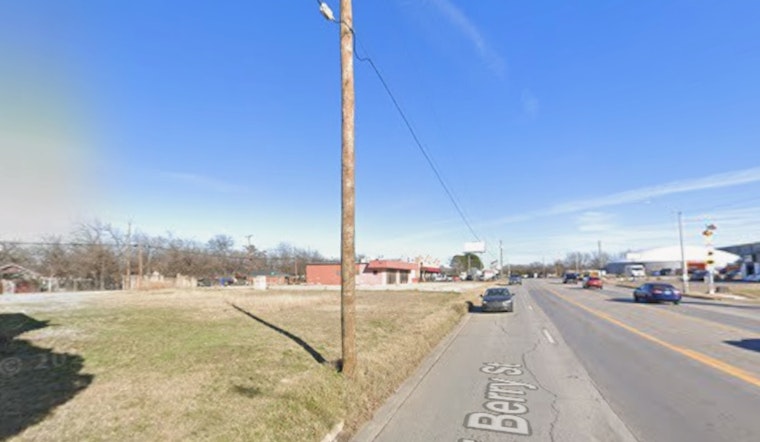
Stop 6 is about to get a new after-hours hangout on E. Berry Street, with a mobile food court headed for 3419 E. Berry that aims to give local food-truck operators a steadier home base and residents more evening dining options close by. The plan calls for at least five trucks and a two-story commissary building on site, though neighbors and city staff have raised concerns about how parking, fencing and late-night activity will play next to nearby single-family homes.
What’s Planned at E. Berry Street
The approved site plan includes a two-story commissary building and pads for five food trucks, with indoor seating on the first floor and an outdoor balcony on the second, according to the City of Fort Worth. The same report notes that the applicant scaled the concept back from an earlier seven-truck layout and that the latest version shows parking, a driveway and perimeter fencing around the site.
The commissary is described as a shared kitchen with restrooms and office space for a site manager, so trucks can stay parked overnight instead of constantly moving on and off the lot. In theory, that setup should help operators keep more regular hours for the neighborhood, rather than chasing customers all over town.
Timeline and Permits
Construction is expected to begin this month, and state licensing paperwork cited by the Fort Worth Star-Telegram lists a 2,568-square-foot commissary building, with work projected to wrap up by July 2026. Developer Manuel Gaona told the paper the team is still nailing down the exact occupants for the truck bays and is actively recruiting permanent tenants for the court.
Gaona said he hopes the food court will be open by late July or August, but he also acknowledged that the final timeline will depend on how quickly permits are approved and how long tenant build-outs take once the trucks are locked in.
How the City Weighed In
City staff initially recommended denying the proposal because the property sits so close to one-family residential lots. Even so, the City Council signed off on the zoning change and a conditional-use permit at its Jan. 13 meeting, according to the City of Fort Worth.
The record shows the approval came with several waivers, including one for front-yard fencing, another allowing parking in a supplemental setback after daylight hours and one for operation near one-family zoning. With those conditions in place, the project can now move ahead to seek building permits and any required health or state licensing for the commissary.
Stop 6’s Comeback Plans
Stop 6, also written Stop Six, has been at the center of long-running revitalization talks, with redevelopment proposals and housing projects aimed at tying the neighborhood more tightly into the city’s economic life, as documented by Downtown Fort Worth, Inc.. In that broader context, supporters see a stable food hub as one small but visible way to bring in jobs and dependable evening activity for nearby residents.
Others are more cautious, worrying about traffic spillover and whether the economic boost will actually reach long-time neighbors or just pass them by. Much of the project’s fate will likely ride on which vendors sign on, how they coordinate hours and parking and how well operators manage noise and crowd control with the surrounding homes.
What’s Next for the Site
Gaona said the development team is actively recruiting food-truck operators now and expects to have leases in place before the commissary itself is finished, according to the Fort Worth Star-Telegram. As permits move through the pipeline, neighbors and code officials will have additional chances to weigh in on how the court operates under its conditional-use permit.
The conditional-use framework also gives the city leverage to enforce operating conditions if problems crop up. We will be watching for permit filings and tenant announcements as construction progresses through the spring and summer.




