

























































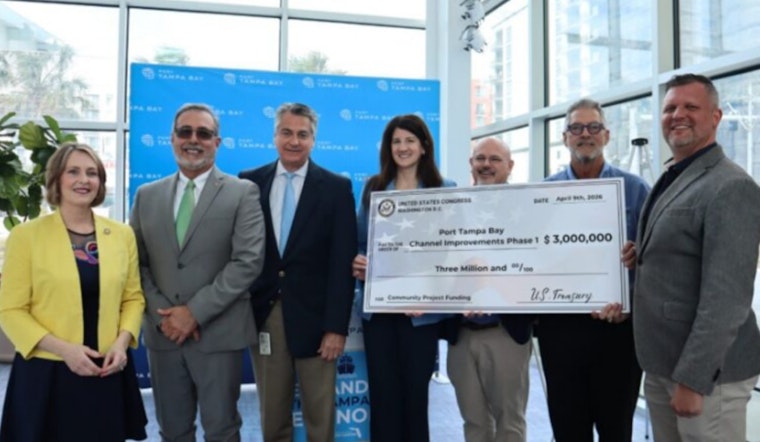
Port Tampa Bay just landed a crucial early win in its long game to deepen the harbor. Port leaders and U.S. Rep. Kathy Castor announced this week that the port will receive a $10 million federal investment to jump-start work on a multibillion-dollar plan to deepen the main shipping channel so larger container, fuel and cruise ships can pull into local terminals. Officials are pitching the cash as an initial but vital step to locking in the region’s supply chains.
According to Dredging Today, about $3 million of the package comes from Rep. Castor’s community project funding, with roughly $7 million flowing through the U.S. Army Corps of Engineers, for a total of $10 million in federal dollars. The outlet reports that the money is earmarked for Phase 1 planning, engineering and design, turning years of study work into concrete pre-construction steps.
What the Federal Boost Will Fund
Port Tampa Bay’s newsroom describes the grant as support for the Tampa Harbor Navigation Improvement Project and notes that recent congressional authorization cleared a key procedural hurdle. As reported by FOX 13 Tampa Bay, officials say that if permitting and financing hold together, early construction could start as soon as 2027. Until then, the port says the focus will be on detailed engineering, environmental review and coordination with industry and community stakeholders before any heavy dredging equipment shows up.
Scope, Dredging and Price Tags
The U.S. Army Corps of Engineers recommends deepening the main stem of the channel to 47 feet mean lower low water and estimates that roughly 21.2 million cubic yards of limestone, sand and silt would be removed from federal channels. Cost estimates are not exactly pocket change: the Tampa Bay Business Journal cites about $1.2 billion for the program, while other local coverage has pegged the price closer to $1.5 billion. Those differences hinge on depth choices, mitigation plans and contingency assumptions, but they all point to the same conclusion that this six-phase navigation upgrade is a massive and technically complex lift.
Why Tampa Is Pushing for It
Local leaders argue that deepening the channels is about more than bragging rights for bigger ships. They say it is central to keeping fuel, building materials and containerized goods flowing into the region. FOX 13 Tampa Bay reports that Port Tampa Bay supplies a large share of Florida’s gasoline and jet fuel and recently handled a record container vessel call. According to port officials, being able to take larger, modern ships directly into Tampa can cut detours, trim shipping costs and protect access to essential supplies. Supporters frame the channel work as both an economic engine and a resilience play for West Central Florida.
Environmental Review and Reuse Plans
The Corps’ study lays out multiple options for where all that dredged material could go and how to offset the environmental hit. The GRR/EIS evaluates offshore disposal at an ocean dredged material disposal site, beneficial reuse to build or enhance islands and habitat, beach placement, seagrass restoration and expected effects on hard-bottom habitat. Environmental groups and local reporting have highlighted concerns about seagrass and other marine resources, and those questions are expected to loom large in permitting and public review. Federal planners detail tradeoffs and mitigation measures in the study, which will guide the next round of agency decisions.
What’s Next
With this first round of federal money in hand, port officials and Castor’s office say the near-term work is about nailing down design, locking in the rest of the funding and completing permits and consultations before any major dredging starts. Remaining non-federal contributions, contract strategies and the Corps’ cost-sharing framework will go a long way in setting both the schedule and the ultimate scope of construction. The expectation is for a long, phased buildout with multiple checkpoints, as each major contract heads through its own public review and approval process.
The $10 million may be a relatively small slice of a billion-dollar program, but officials describe it as the shove that moves the Tampa Harbor plan off the report shelf and toward the water, where sonar maps start turning into working dredges.





