

























































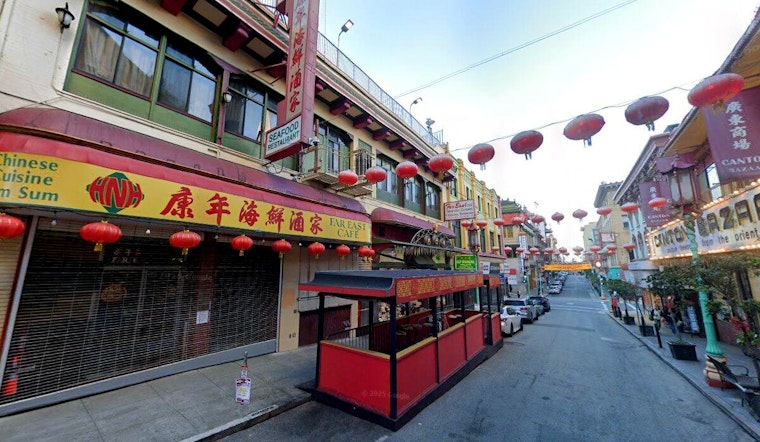
Far East Cafe, the century-old banquet hall at 631 Grant Avenue that locals fought to keep alive through the darkest stretch of the pandemic, has been ordered immediately closed by San Francisco health inspectors. The Department of Public Health suspended the restaurant's permit and posted a red closure placard during a routine inspection on May 27, 2026, after documenting an active rodent infestation throughout the kitchen, upper storage areas, and ware-washing station — including a deceased rodent under the cook line and a bag of flour that had been gnawed open by rats.
What Inspectors Found
The inspection report, signed by inspector Michael Mooney, lays out a grim picture across all four pages. Investigators observed rodent droppings in the ware-washing area, at the end of a prep-top refrigerator near the dumbwaiter, and behind boxes and stored products in a room at the top of the stairs on the building's north end. The report also flagged a container of cooked meat in the walk-in growing a mold-like substance, and a large bag of flour adulterated by rodent feces — both voluntarily discarded by staff during the inspection.
The closure was issued under Sections 114405 and 114409 of the California Health and Safety Code, the statute that lets the city order a facility shut when conditions pose an imminent public health hazard. The restaurant was also cited for a household-use can of insect spray stored in a cabinet — a recurring red flag inspectors treat seriously, since over-the-counter pesticides aren't approved for use around food and signal an operator trying to handle a pest problem without a licensed professional. Per the report, the city is requiring documentation of professional pest control and a deep cleaning of the area under the cook line before any reinspection.
Not everything was rodent-related. Inspectors clocked the main cook-line refrigerator holding at 44.9°F and the walk-in at 43.9°F — both above the 41°F maximum for potentially hazardous foods — though that violation was corrected on site. They also noted raw meat stored above ready-to-eat food in a freezer, bowls being used as scoops in dry goods, heavy grease buildup on fan guards and condenser units, and worn, debris-caked grout along the kitchen flooring, which the report itself notes "can contribute to vermin."
A Painful Turn for a Restaurant the City Rallied to Save
The irony here is hard to miss for anyone who followed Chinatown through 2020 and 2021. Far East Cafe, which opened in 1920 and bills itself as the neighborhood's oldest banquet-style Chinese restaurant, was on the brink of permanent closure at the end of 2020. As ABC7 News reported at the time, the announced shutdown prompted Chinatown merchants to publicly demand more city support, with one neighbor calling the situation "a disaster."
The restaurant got a reprieve. Supervisors Aaron Peskin and Sandra Lee Fewer pushed a $1.9 million Chinatown Restaurant Support & Food Security package that paid neighborhood restaurants to cook meals for seniors and families in SRO hotels, and Far East Cafe was put to work feeding the community. The 100-year-old banquet hall pulled back from the edge and decided to keep its doors open after all, helped along by a landlord who, according to the San Francisco Chronicle via Sing Tao Daily, cut its rent in half and granted six months free. A restaurant the city spent real money and political capital to rescue is now sitting behind a closure placard for reasons that have nothing to do with the pandemic.
Part of a Citywide Pattern
Far East Cafe is far from alone. San Francisco has logged a steady drumbeat of rodent-driven restaurant closures over the past year, and Chinatown and its surrounding districts have featured prominently. In September 2025, Mission District staple Mission Hunan was temporarily shuttered after inspectors found rodent activity in stored onions and discarded multiple bulk bags of adulterated rice and flour, as documented by WhatNow SF. Little Szechuan was ordered closed that July over a rodent and cockroach infestation, and a string of breakfast spots, taquerias, and an Italian restaurant followed through the fall.
Even the city's most prominent dining rooms haven't been spared. In January, inspectors cited a "major" rodent infestation at the Gov. Newsom-linked Balboa Cafe and gave the storied saloon just one week to fix it. San Francisco has long ranked among the country's worst cities for rodents — a function of dense development, aging infrastructure, and proximity to water, according to pest-control industry data.
Part of the difficulty may be regulatory. As NBC Bay Area reported, California's Poison-Free Wildlife Act, which took effect in early 2025, restricts the anticoagulant rat poisons that pest-control operators have historically relied on, pushing them toward slower exclusion-and-trapping methods. Industry experts have linked the law to prolonged closures — a Cupertino Whole Foods sat shuttered for more than three months in 2025 — and the inspector's notes at Far East Cafe, which suggest consulting a pest control operator about cameras, indicator-dye monitoring, and inspecting the dumbwaiter shaft, read like a roadmap for exactly that kind of labor-intensive remediation.
What Happens Next
To reopen, Far East Cafe must eliminate the infestation using only approved methods, remove all damaged products, clean and sanitize the affected areas, and rodent-proof entry points using approved materials. The report specifically asks the operator to weigh measures like surveillance cameras to assess activity and inspection of the dumbwaiter shaft and the area visible from the alley under the dining room. The city requires proof of professional pest control and documentation of the cook-line cleaning submitted by email before a reinspection will be scheduled.
The permit holder, listed as Hong Nin Holdings Corporation, has the right to request a hearing within 15 calendar days to contest the suspension. Under the closure notice, an owner, manager, or operator who ignores the order and keeps serving food can be charged with a misdemeanor carrying a possible $1,000 fine and up to six months in jail per offense. The closure report also notes that a complaint investigation was conducted alongside the routine inspection, suggesting the visit may have been prompted in part by a tip.
For now, one of the last grand banquet halls in a Chinatown that has steadily lost them sits closed — not by economics this time, but by the rats. Whether the restaurant that the city once "beseeched" to hang on can clear the violations and reopen is the open question hanging over Grant Avenue.
Editor's Note: The title was refined to more clearly identify how San Francisco spent the $1.9M.



