

























































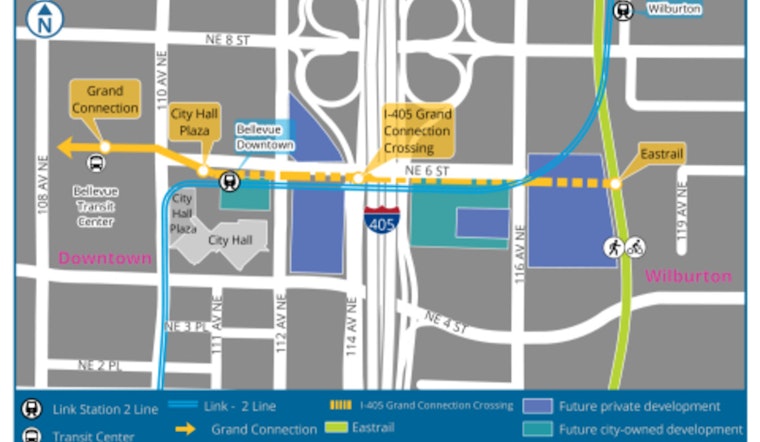
Bellevue’s long‑planned Grand Connection Crossing, a fully separated pedestrian and bike bridge over I‑405 that would stitch downtown to Wilburton and the Eastrail, has cleared a big political test. The city has now lined up commitments from key regional taxing districts, removing a major hurdle for a project Bellevue estimates will cost roughly $200 to $225 million. The City Council is set to take up a final ordinance to establish a tax‑increment financing district at a special meeting on May 20, 2026.
All five local taxing authorities that needed to opt in, the King County Library System, the Port of Seattle, Sound Transit, the King County Council and the county flood‑control district, have signed off on Bellevue’s plan. Under the proposal, assessed values inside a defined area would be frozen and future increases over 25 years would be routed back to repay project debt, according to The Urbanist. The outlet reports the tax‑increment financing, or TIF, is expected to cover roughly 15% of the bridge’s total cost.
Regional support and economic case
Regional agencies and business groups have been lining up behind the project on paper, too. Letters and public comments filed in support describe the Grand Connection Crossing as a catalyst for new housing and economic activity and a key link between transit hubs, according to documents submitted to Sound Transit. A packet from the Friends of the Grand Connection included in those records estimates the bridge could help unlock roughly 15,000 housing units and pegs its total cost in the low‑$200 millions.
City office, design push and timeline
Bellevue has already started organizing around the corridor. In July 2025, the city created an Office of the Grand Connection and tapped Nathan Torgelson to lead design, outreach and redevelopment work in the area, the city says. Officials also note that Bellevue submitted a project analysis to the Washington State Treasurer for review and set aside capital in its 2025–2030 Capital Investment Program to keep design work moving, according to the City of Bellevue.
Funding trade‑offs and political reaction
Backers have framed the Grand Connection Crossing as a regional play that would speed up housing production, expand safe access to transit and create jobs. Some county leaders, though, have raised concerns about diverting future general‑fund revenue and taking on long‑term interest payments.
Bellevue Deputy Mayor Dave Hamilton has called the project a “no‑brainer” for housing and connectivity. King County budget chair Rod Dembowski, on the other hand, has warned that the financing structure could put pressure on public‑safety dollars. The County capped its TIF contribution at $30 million and imposed a similar ceiling for the flood‑control district, according to The Urbanist.
What’s next
The City Council’s special meeting to vote on the ordinance establishing the TIF district is scheduled for 4:30 p.m. on May 20 at Bellevue City Hall, 450 110th Avenue NE, the city says. If the council signs off on the boundary and financing plan, Bellevue would then move to assemble a full funding package, layering debt, grants, philanthropic support and Transportation Benefit District revenue to push construction forward, with a target opening around 2030, according to city officials.
Legal note
Under state law, cities must submit a project analysis to the Office of the State Treasurer for review before they adopt a tax‑increment area. The Treasurer’s review of Bellevue’s draft project analysis falls under that requirement and is meant to flag risks and assumptions that the city will need to address as it locks in its financing plan, according to the Treasurer’s review of Bellevue’s TIF submission.
Whether the bridge actually delivers the dense, transit‑oriented development that planners are envisioning will depend largely on how fast private projects follow the public investment and how the final funding stack comes together. The May 20 vote will set Bellevue’s next, decisive steps toward stitching downtown to Eastrail and the waterfront.



