

























































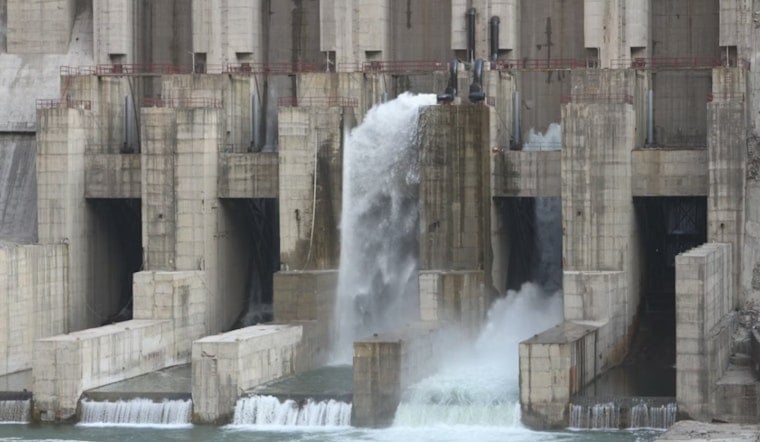
Dead fish are turning up this week below Pensacola Dam in the northern reaches of Lake Hudson and along the Grand River channel, and the sight has regulators back on the water with clipboards and sample jars. Residents and lake users first spotted the carcasses and reported them, prompting the Grand River Dam Authority and partner agencies to launch field surveys and collect samples to figure out what is going on. The bodies appear to be clustered in pockets downstream of the dam and along shoreline areas frequented by anglers and boaters.
In a statement to FOX23, GRDA’s ecosystems and watershed management department said it opened an inquiry earlier in the week after getting the first calls and that the dead fish are “mostly catfish” found in Lake Hudson. GRDA spokesman Justin Alberty told the outlet that none of the water quality parameters the agency routinely monitors are outside normal ranges.
GRDA points to floodgate operations and spawning
GRDA investigators told local media they believe recent floodgate operations, combined with fish spawning behavior, likely played a role by stressing fish and sending carcasses downstream. GRDA's floodwater release bulletin shows that Pensacola Dam had both generation and gate releases in late April; for example, one bulletin reported one spillway gate open and combined releases of roughly 13,760 cubic feet per second on April 23. Officials say those kinds of flows can change velocity and water levels quickly and can concentrate fish mortalities in the channel below the dam. GRDA published the release figures and lake elevations in a public bulletin.
Why fish sometimes die suddenly
Biologists note that fish kills commonly stem from sharp drops in dissolved oxygen that are triggered by algal die offs, decomposition of organic matter or sudden mixing of water layers, although chemical discharges or disease can also be involved. The U.S. Environmental Protection Agency points out that harmful algal blooms and oxygen depletion are frequent drivers of freshwater die offs, and Oklahoma State University Extension explains that short lived oxygen crashes can easily be missed by routine water sampling. Those expert resources help explain how monitors can show “normal” readings even when a brief pulse of poor conditions causes a local fish kill. EPA and Oklahoma State University Extension offer background on typical causes and investigation methods.
What officials want residents to do
GRDA is asking people to steer clear of areas with floating or beached dead fish, avoid handling carcasses and report sightings so investigators can map out the scope of the incident. The authority's public guidance mirrors state recommendations and notes that the Oklahoma Department of Environmental Quality plays a lead role in fish kill response and sample analysis; ODEQ also posts a government handout that explains reporting steps and what investigators look for. Residents with tips or possible samples can contact GRDA’s non emergency police line at 918-256-0911 or the authority’s media line at 918-824-7812 for more information. GRDA and the state handout describe how and when officials will test water and fish specimens.
Not the first time for Lake Hudson
Lake Hudson has seen this before. In 2021 GRDA reported that an estimated 1,300 fish, mainly blue catfish, died over a short period, and at the time officials linked the losses to floodgate activity during spawning while assuring the public that biologists expected the population to recover. That episode highlighted how flow management and natural life cycle timing can collide to produce localized kills along river channels. News On 6 reviewed the earlier investigation and response.
GRDA says the current inquiry is still underway and agencies are continuing to analyze samples, with officials pledging to share results as tests are completed. For now, residents are advised to avoid affected shorelines, report dead fish sightings to the Oklahoma Department of Environmental Quality or to GRDA, and check with local agencies before spending time in parts of Lake Hudson. As reported by FOX23, investigators are still collecting data and coordinating with state partners.





