

























































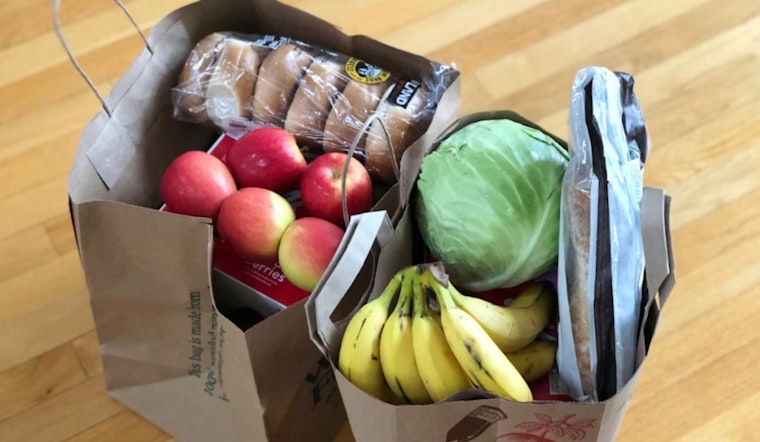
Ordering dinner to your doorstep in D.C. could soon cost an extra 20 cents per drop-off.
Councilmember Brianne Nadeau is pushing a 20-cent surcharge on every food and grocery delivery that terminates in Washington, D.C. The modest charge is projected to generate nearly $7 million a year and would be set aside for grocery-access programs, support services for delivery drivers and financial assistance for local restaurants. The proposal appears in the Committee on Public Works and Operations' Fiscal Year 2027 budget report released May 21, 2026. The amendment remains under debate, and it is not yet clear whether it has the votes to make it into the final budget.
What’s in the proposal
As outlined in the Committee on Public Works & Operations' FY27 budget report, a proposed "Carrier-For-Hire and Food Access Support" subtitle would assess a 20-cent surcharge on carrier-for-hire deliveries that terminate in the District and expand the Department of For-Hire Vehicles' special-purpose revenue fund to pay for driver supports, grocery-access programs and restaurant assistance, as detailed by Committee on Public Works. The committee frames the surcharge as a targeted revenue source to help cover the costs of regulating an expanding delivery economy and to seed food-access initiatives.
How much it would raise
City analysts estimate the surcharge could bring in nearly $7 million a year, a figure reported by WJLA. That story also noted the amendment’s fate is uncertain as the Council continues FY27 budget deliberations.
Where the money would go
The committee's report lays out where the surcharge revenue would be steered. It lists $413,000 to restore the Office of Food Policy and the Food Policy Council, $200,000 for a Grocery Access Pilot to enable over 1,000 low-income residents to buy groceries online without delivery fees, $200,000 to restore Dreaming Out Loud’s grocery deliveries for seniors, $300,000 in recurring funds to reduce the Produce Plus waitlist, $107,000 for farmers-market support grants and $500,000 to support Food and Friends’ Ward 5 renovation; the report also recommends a $1 million recurring allocation for Nourish DC, as detailed by Committee on Public Works. Taken together, those line items show the committee pairing a small recurring revenue stream with locally targeted food-access and workforce supports.
How D.C. compares
D.C. would not be the first to tack a flat fee onto deliveries. Minnesota imposes a 50-cent retail delivery fee on qualifying deliveries of $100 or more under state law, and Colorado charges roughly 28 to 29 cents per delivery, according to the Minnesota statute and the Colorado Department of Revenue.
What comes next
The Public Works committee's recommendations now move to the Committee of the Whole and then to a full Council vote, where members will decide whether the surcharge is adopted. Supporters say the modest fee would create a dedicated pot for driver safety programs and to reduce barriers to online groceries for low-income residents. Policy analysts, meanwhile, warn such per-delivery charges can be regressive or an inefficient way to close budget gaps, as the Tax Foundation has argued. Councilmembers are continuing FY27 budget deliberations, and the amendment's inclusion remains uncertain.





