

























































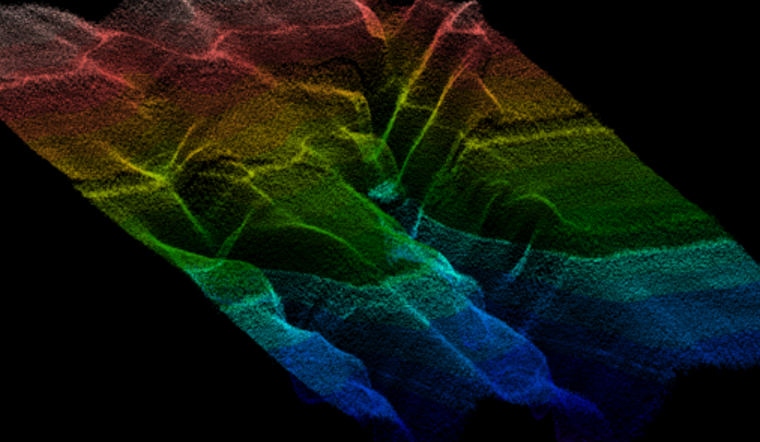
Florida has quietly pulled off one of the most ambitious underwater mapping efforts in the country. State officials say airborne LiDAR flights are now complete, and most of the vessel-based sonar work is in the can, setting the stage for what they describe as the most detailed statewide seafloor elevation model any U.S. state has attempted.
In a press release from the Florida Department of Environmental Protection, officials said the Florida Seafloor Mapping Initiative has covered more than 75,500 square kilometers with LiDAR and more than 64,000 square kilometers with sonar. Before the program launched, only about 25,600 square kilometers had been mapped. Processed products from the project are expected to go public in the fall of 2026. “Florida’s coastline is one of our state’s greatest natural and economic assets,” DEP Secretary Alexis A. Lambert said in the release.
New features emerging offshore
Even in early analysis, the new datasets are surfacing hidden features on the seafloor, including ancient shorelines, buried river channels, karst formations, and offshore sand deposits that could influence sediment-transport studies and restoration strategies. Scientists have also flagged previously unknown mesophotic coral reefs more than 50 kilometers offshore of Pensacola and paleoriver channels near Miami, according to West Orlando News.
How Florida built its seafloor map
The initiative blended topobathymetric LiDAR, which uses airborne lasers to map shallow waters, with vessel-based multibeam sonar for the deeper areas. Unmanned surface vehicles and dedicated survey vessels were brought in to speed things up. Operators such as Saildrone and contractors including Dewberry and Fugro contributed both data and processing muscle.
Plugging into coastal planning
FSMI outputs are being integrated with inland elevation data through the U.S. Geological Survey’s Coastal National Elevation Database Applications project, creating a continuous onshore–offshore digital elevation model for planners to use in resiliency work, flood modeling, and habitat restoration. Coverage of the program also notes that the initiative started with a $100 million state allocation and is meant to guide beach nourishment, infrastructure siting, and conservation decisions, as reported by Esri.
What happens next
Processed datasets and map products are scheduled for public release in fall 2026, and state officials say partner agencies plan to fold the information into permitting and planning as soon as it is available. The department is also collaborating with the National Oceanic and Atmospheric Administration on remotely operated vehicle dives and targeted scientific sampling to get a better handle on the newly identified deep reefs and other habitats, according to NOAA Ocean Exploration.
For shoreline communities and coastal managers, the mapping effort could help lower the cost of beach restoration, pinpoint offshore sand sources, and sharpen storm-surge and flood models. The FSMI dashboard at the Florida Geographic Information Office tracks survey progress and will host the data once it is released: FloridaGIO FSMI dashboard.




