

























































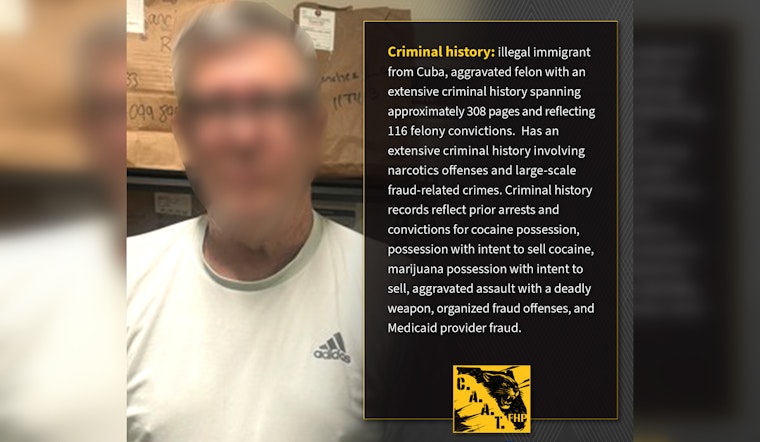
Florida highway troopers say they have just booked a Cuban national whose alleged criminal record is so long it runs about 308 pages and includes 116 felony convictions, from narcotics offenses to large-scale fraud and aggravated assault.
State officials say the person has been under a final order of removal since May 1998 and described the individual as an aggravated felon. The arrest is being touted as part of Florida's ongoing campaign to find and remove noncitizens with criminal histories.
A Cuban national with a final order of removal since May 1998🤝 You can only outrun consequences for so long...👋 #FHP #Booked #SeeYaNever #StateTrooper https://x.com/i/status/2053944041360789704
— FLHSMV (@FLHSMV) May 11, 2026
In a social media post, the Florida Department of Highway Safety and Motor Vehicles said its Criminal Alien Apprehension Team (CAAT) booked the individual and flagged an "extensive criminal history" that includes 116 felony convictions across "approximately 308 pages" of records. The agency listed narcotics offenses, possession with intent to sell, aggravated assault with a deadly weapon, organized fraud and Medicaid provider fraud among the alleged prior crimes, and said the suspect has had a final order of removal in place since May 1998. FLHSMV on X provided the initial public account.
The Criminal Alien Apprehension Team, a unit of the Florida Highway Patrol that works with federal partners to identify and detain noncitizens who have criminal records, has been behind a series of similar arrests around the state. One recent case in Orange County, highlighted in Troopers Nab Haitian National, detailed another CAAT arrest tied to a broader crime sweep. National reporting on a March operation in Key Largo said CAAT and federal agents took 15 people into custody, and Fox News noted that sweep was presented as part of a wider enforcement push by state officials.
What a "final order of removal" means
A "final order of removal" is the point in an immigration case when a judge or appellate body has ordered someone deported and that order is legally enforceable unless it is later reopened or overturned. Federal rules allow immigration officers to reinstate and carry out prior removal orders if a person reenters the United States illegally.
The eCFR explains those procedures in 8 C.F.R. § 241.8, which lays out how officers can bring back older removal orders, verify identity and past orders, and either execute removal or refer people into further immigration proceedings.
Deportation to Cuba can be complicated
Even with a final order in place, actually removing Cuban nationals has often been a diplomatic and logistical tangle. At various points, the Cuban government has refused to accept some migrants, particularly those with criminal records.
The U.S. government has resumed limited deportation flights to Cuba this year, and local reporting says that shift is changing how officials approach returns for Cubans with criminal histories. The Miami Herald has outlined how the restarted flights and related policy changes are affecting those enforcement efforts.
What officials have not said
So far, Florida officials have left some basic questions unanswered. The agency's post did not identify the person by name, did not specify where the booking took place, and did not attach court documents or a jail booking sheet.
At this point, the social media announcement is the primary public account of the case. Local court dockets and federal detention records are likely to be the next places where formal charges, custody status or any transfer to federal immigration authorities will show up.
For now, the FLHSMV is clearly framing the case as part of Florida's broader strategy to track down and remove noncitizens with criminal records, underscoring how state and federal enforcement efforts overlap on immigration. Additional public records or agency releases will be needed to fill in key details about the person, the precise charges and any pending federal action.





