

























































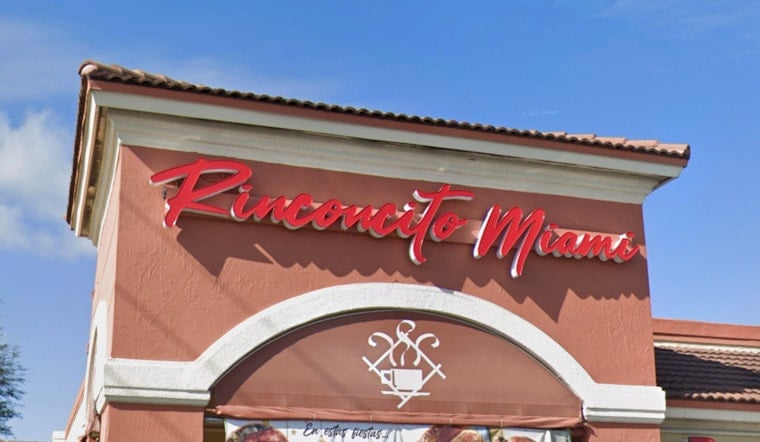
A restaurant in unincorporated Southwest Miami-Dade was hit with 63 health code violations during a single unannounced inspection on August 11, yet inspectors let it keep serving customers. Rinconcito Miami 2, located at 15956 SW 137th Ave. in the Country Mall Plaza near West Kendall/Richmond West, saw state inspectors document a dead roach near the dishwasher, mold-like buildup inside a blender and ice machine, and food sitting well outside safe temperature ranges.
The inspection was documented by WPLG Local 10 as part of its long-running Dirty Dining coverage, reported by investigative journalist Jeff Weinsier. Inspectors found two live flies in the kitchen, food stored uncovered in the vegetable walk-in cooler, and food kept directly on the floor of the walk-in freezer. They also issued a stop-sale order for time/temperature-control-for-safety food, a designation reserved for items capable of supporting rapid bacterial growth if mishandled.
Cold Food Cooking, Hot Food Cooling
The temperature readings alone painted a troubling picture. Cooked noodles sat at 57 degrees Fahrenheit in a walk-in cooler, pork belly at 60 degrees, raw pork also at 60 degrees, and raw shrimp at 59 degrees — all well above the 41-degree threshold considered safe for cold storage, according to the same Local 10 report. Meanwhile hot items ran dangerously cool: cooked onions were held at 82 degrees, maduros at 92, cooked chicken at 106, malanga cream at 121, yucca at 123, and milk at a comparatively better but still noncompliant 127 degrees, all short of the 135-degree minimum required to keep hot food safe.
Those readings fall squarely inside what the FDA Model Food Code calls the temperature danger zone, the range between 41°F and 135°F in which pathogens such as Salmonella and E. coli can double in population roughly every 20 minutes, according to TransAct Technologies. Standard food safety rules call for time/temperature-control-for-safety foods held in that zone for more than four hours to be thrown out rather than served. A walk-in cooler at the restaurant was also measured at 50 degrees, and rice and beans were found at 96 degrees.
Handwashing And Sanitation Breakdowns
Beyond temperature abuse, inspectors documented a cascade of hygiene failures throughout the kitchen. Employees washed their hands with cold water and, in at least one case, used an improper sink altogether. One handwashing sink was blocked by a baking sheet and a metal food container, another was being used to store containers and other items, and a third had a broken soap dispenser. Multiple sinks reportedly lacked adequate running water or pressure, and water drained onto the floor from at least one station, while a leaking pipe was found under a handwashing sink near the walk-in cooler.
Staff also handled food and clean equipment without washing their hands, and employees touched a trash can and a soiled apron before returning to food prep without washing up, per the inspection report cited by Local 10. Tongs were stored on an oven door handle between uses instead of a proper holder, and a can opener was found soiled with old food debris. Standing water pooled in front of the walk-in freezer, and the kitchen floors, walls and equipment showed grease, food debris, dirt, slime or dust throughout.
Why The Restaurant Wasn't Shut Down
Despite the sheer scale of the violations, Rinconcito Miami 2 was not shut down after the inspection. Under Florida Statute Chapter 509, the Department of Business and Professional Regulation reserves immediate emergency closures for conditions presenting an acute public health hazard, such as active pest infestations or sewage backups, according to Florida DBPR. High violation counts without that kind of acute hazard instead trigger warning notices and scheduled callback inspections rather than an immediate shutdown, per Elevate Legal Services.facilities that do receive emergency closures must clear all high-priority items and pass a 24-hour callback before reopening.
DBPR classifies violations into three tiers — High Priority, which poses a direct threat of foodborne illness; Intermediate, covering procedural or training gaps; and Basic, general physical plant and sanitation maintenance — a framework the state adopted in 2013 to replace its older binary critical and noncritical system, per MyFloridaLicense.com. Inspectors also noted that the certified food manager or person in charge on site lacked knowledge of employee health policy and requirements. Florida rules require at least one Certified Food Protection Manager on duty whenever four or more staff members are involved in food prep or service, and certification gaps like this rank among the most common violations cited statewide, according to SunComply.
35 Violations Still Unresolved At Follow-Up
A callback inspection the following day, August 12, found that 35 of the original 63 violations remained uncorrected. That leaves the restaurant exposed to further administrative action: under Florida Statute § 509.261, DBPR's Division of Hotels and Restaurants can impose fines up to $1,000 per violation per day and can pursue license suspension or revocation against establishments that don't come into compliance, per the state's enforcement authority outlined by MyFloridaLicense.com. Administrative complaints are typically filed once warning periods expire without adequate corrective action.
Rinconcito Miami 2's 63-violation count more than doubles the 30-violation benchmark that Local 10's long-running Dirty Dining segment uses to flag South Florida establishments for closer scrutiny, a threshold Hoodline has previously tracked in Miami. It also fits a broader pattern this year: state inspectors have temporarily shut down multiple South Florida restaurants after finding live roaches, sewage backups and temperature abuse, according to Edible Manhattan, with those closures across Miami-Dade, Broward and Palm Beach counties requiring full remediation before reopening.
Nationally, CDC surveillance data attributes roughly 800 foodborne illness outbreaks a year to conditions like these, causing about 15,000 illnesses, 800 hospitalizations and 20 deaths, with improper cooling and temperature holding among the leading causes. It remains an open question whether DBPR will move toward a formal administrative complaint against Rinconcito Miami 2 or grant the restaurant additional time to correct its remaining citations at a future callback.




