

























































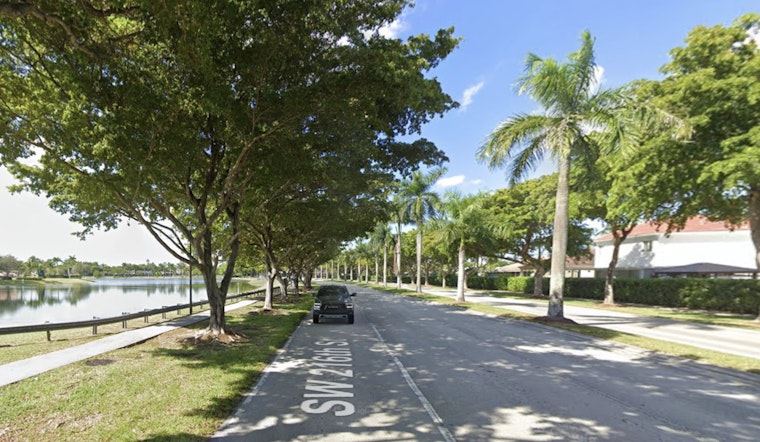
South Florida sidewalks are wild enough without secret snake lairs, but weekend walkers in Cutler Bay stumbled on exactly that when they spotted a massive Burmese python tucked beneath a raised stretch of concrete on Southwest 216th Street. Wildlife crews later pulled out the adult snake and removed a nest of roughly 20 eggs, which were destroyed to keep a new batch of hatchlings from slithering into the neighborhood. One contracted trapper was bitten in the process, and neighbors say they are still uneasy about what else might be lurking in the nearby brush.
Danny Okoinyan told WSVN he first spotted the snake while walking to a neighborhood gym and filmed video of the discovery. He described the sidewalk as slightly lifted, with part of the python tucked under the pavement and the rest coiled along a fence. Unsure of what he was seeing at first, Okoinyan said he dialed the Florida Fish and Wildlife Conservation Commission for help. “I see something that look like a pipe,” he told the station, before realizing, “it’s a python.”
Trapper bitten, eggs destroyed
The Florida Fish and Wildlife Conservation Commission sent out contractor Guillermo Tapanes, a python removal specialist with the South Florida Water Management District, to wrangle the snake, according to the Miami Herald. In the struggle, Tapanes was bitten on his right hand, but he still managed to secure the adult snake and recover about 20 eggs from the nest. Officials told the Herald the eggs were destroyed so that hatchlings would not disperse into nearby yards.
Why pythons are a problem
Burmese pythons can lay large clutches of eggs and have already reshaped food webs across South Florida, which is why wildlife managers urgently target breeding females when they find them. The USGS notes that pythons in the Everglades typically mate in winter through spring and hatch in mid to late summer, which gives removal teams a limited seasonal window to intercept nests. That timing is part of what makes finds like the Cutler Bay clutch a high priority for crews trying to slow the invasive population.
The agency advises residents not to try to handle pythons or their eggs. If you spot a snake, officials say to report it to the FWC Exotic Species hotline at 888-Ive-Got1 (483-4681), as outlined on the Florida Fish and Wildlife Conservation Commission site. Trained contractors and FWC teams are equipped to capture and humanely euthanize nonnative pythons, and residents are urged to keep children and pets away from the area until responders arrive. Local removal programs and community reporting remain key tools in keeping neighborhoods safer as invasive snake season rolls on.





