

























































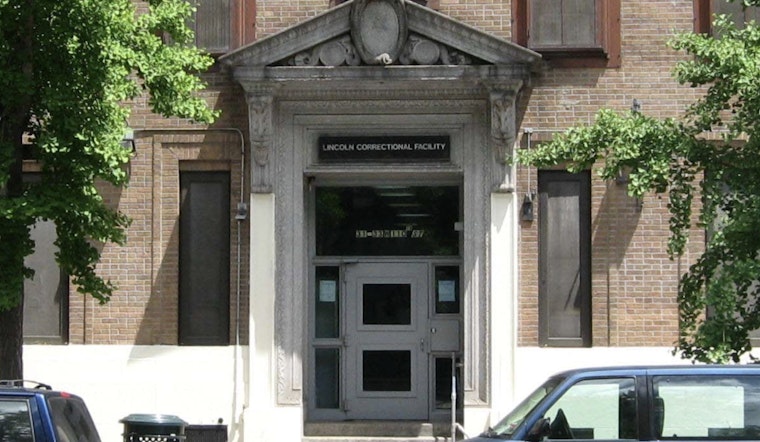
The long-vacant Lincoln Correctional Facility on Central Park North is finally getting a new chapter: roughly $97.8 million in financing has closed to turn the former prison into 105 permanently affordable cooperative homes. The plan stacks 14 new floors on top of the existing eight-story structure for a 22-story, all-electric building that overlooks Central Park, with community space and several terraces facing the park. The development team is led by Lemor Development Group along with Infinite Horizons, L+M Development Partners and Urbane Development Group.
New York YIMBY reports that the financing covers an approximately 148,000-square-foot project at 31–33 West 110th Street. Designers’ materials show a refreshed façade with a three-story cutout at the entrance and a green-clad pavilion topping the roof. The building is being pitched as an affordable co-op, with homes reserved for households earning between 40 and 100 percent of area median income. Renderings depict a community room, a children’s playroom and a coworking lounge among the on-site amenities.
State backing and funding
State officials are casting the redevelopment as a public-private effort to put long-underused state property back to work. In a February statement, New York State Homes and Community Renewal said the Public Authorities Control Board signed off on about $18.7 million in state housing capital for the project, paired with support from New York City’s Open Door program and $10 million from the state legislature. State materials say the plan is expected to generate hundreds of construction jobs, with occupancy targeted around 2028.
Design, sustainability and community space
Design guidelines and the project page from Empire State Development highlight a high-performance approach: the new tower is planned as fully electric and intended to meet Passive House or similar decarbonization standards, a relatively rare goal for a large affordable housing project in New York. State documents also outline roughly 7,500 square feet of ground-floor community facility space aimed at arts, education and cultural programming, along with MWBE and local-hiring benchmarks tied to the majority-minority development team.
According to developers and the state, construction will kick off once the financing fully closes and permits are in hand, with the conversion, sometimes listed as “Seneca” in filings, replacing the vacant facility that closed in 2019. Reporting from Commercial Observer and state records track the PACB approval and the broader nearly-$100 million investment behind the effort, while neighbors and housing advocates are expected to keep a close eye on how the co-op sales and housing lottery rules are set once the homes are ready to hit the market.



