

























































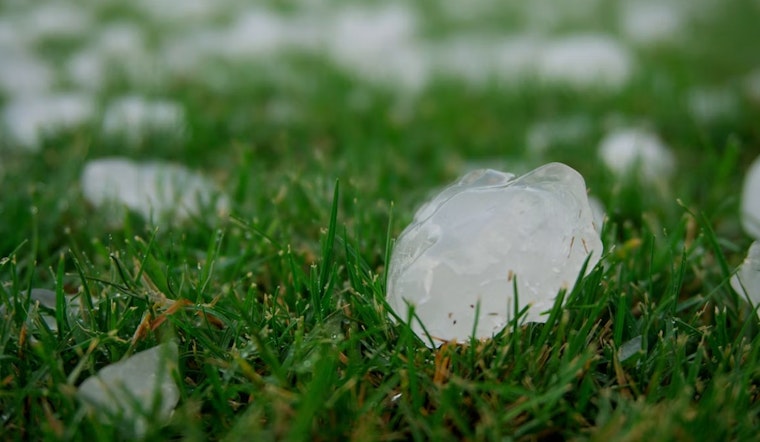
A new global study is throwing a curveball at the usual hail forecast, warning that a warmer planet could trade lots of little hailstones for fewer but much bigger, more expensive ones. Climate models suggest that storms capable of producing hail larger than about 1.2 inches, roughly the size of a marble or a U.S. half-dollar, could become substantially more common by the end of this century. For homeowners and cities, that shift could turn what used to be a few harmless dings into full-blown replacement jobs for roofs, cars and solar panels.
The research, published in Nature and summarized in this week's reporting, used three emissions scenarios and three-dimensional hail-formation modeling to estimate how hail sizes might change. The authors project that events producing hail larger than 1.2 inches will increase 38% to 47% by 2100 while storms that produce smaller hail will decline 4% to 8%, according to The Associated Press. The higher increase shows up under a hotter, high-emissions pathway, but even a cleaner, less-polluting trajectory still comes with a sizable uptick in big stones.
How warming makes hail grow
Warmer air holds more moisture, about 4% more water vapor per degree Fahrenheit, which strengthens thunderstorm updrafts and gives hail embryos more time to collect layers of ice so they can bulk up before falling. At the same time, the melting layer in the atmosphere moves higher, so many smaller stones melt away before reaching the ground while the largest ones survive. That combination shifts the size distribution toward more damaging hail, according to Nature Reviews Earth & Environment.
Where the changes will be biggest
The study points to Argentina, parts of Europe, Canada and the U.S. Northern Plains as likely hotspots for the biggest jumps in damaging hail, while parts of the deep tropics could actually see declines because smaller stones tend to melt before they hit the ground, as reported by The Associated Press. Scientists caution that how hard communities get hit will depend heavily on exposure and resilience, including where and how buildings are constructed, and that research teams are working to turn these findings into better warnings and design guidance, per Northern Illinois University coverage of the ICECHIP campaign NIU Newsroom.
What this could mean for San Diego
San Diego and much of Southern California sit well outside the nation’s main "hail alley" and log far fewer large-hail reports than the Plains and Texas, according to compiled NOAA-based hail records from HailDrive. Still, if the overall size distribution creeps toward more golf ball to baseball size stones, the financial stakes climb quickly. Large hail can dent cars, puncture roof shingles and damage rooftop solar arrays, hazards documented in field research by the Insurance Institute for Business & Home Safety IBHS.
Scientists are already chasing hail
To cut through some of the uncertainty, the ICECHIP field campaign sent nearly 100 scientists into the Plains during May and June 2025 to collect hail, radar and impact measurements. The Central Michigan University team co-leading ICECHIP says the data will sharpen radar detection, computer modeling and damage prediction, according to the CMU Allen Research Group. Field teams measured, weighed and even crushed thousands of stones to document size, strength and hailswath patterns that can be used to better connect model output with real-world damage estimates.
“With improved detection and prediction of severe hail—and with a better understanding of hail characteristics and surface impacts—people could better protect themselves and their belongings,” NIU Newsroom quoted lead scientist Victor Gensini as saying about why the campaign matters. For San Diego officials, installers and homeowners, the takeaway is straightforward: if models keep pointing toward more large hail in some regions, resilience measures like hail-resistant roofing, smart siting of solar arrays and up-to-date insurance will help decide whether future storms become a string of costly disasters or mostly manageable repair jobs.




