

























































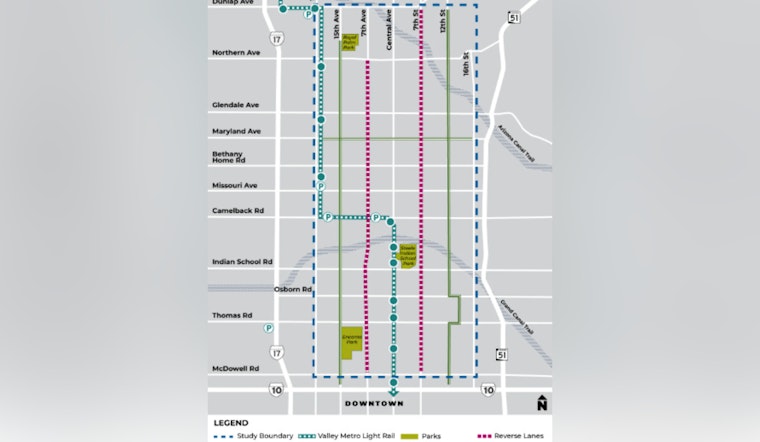
Phoenix is reopening one of Midtown’s most divisive traffic debates: what to do with the reversible lanes on 7th Avenue and 7th Street. The city this week launched a new Midtown Core Transportation Study, and officials are hosting a virtual public meeting Thursday night to walk through early findings and let residents, businesses and transit riders sound off.
Study area and goals
The study zone stretches across Midtown from 19th Avenue east to 16th Street and from McDowell Road north to Dunlap Avenue. It is designed to look at how the area’s street network serves drivers, transit riders, pedestrians and cyclists. According to the City of Phoenix, the team will compare existing capacity to future demand, prioritize potential projects and take a hard look at the long-term role of the 7th Avenue and 7th Street reversible lanes. The city says Thursday’s meeting will be recorded, and that an online feedback form and interactive map will stay open through May 29 for public comments.
Data, consultants and timeline
Consultants are already in the field gathering numbers. KTAR News reports that crews are collecting traffic data at about 60 intersections and setting up roughly 30 to 40 speed-monitoring locations during a two-week collection window. KTAR News also notes the study is structured in four parts: corridor analysis, scenario development, choosing a preferred plan and preparing a final report, with all that field work and modeling feeding into a recommendation for the City Council later this year. City Council records show the administration has brought in WSP to assist with central-city transportation work, lining up with the consultant listed by the project team.
Why the "7s" are contentious
Neighborhood groups and some business owners have been calling for the reversible lanes to go, arguing they confuse drivers, increase crash risks and make customer access tougher. Local coverage and advocacy efforts have helped push those concerns into the spotlight; ABC15 reports that petitions and organized neighborhood pressure were key in getting the city to formally study alternatives. At the same time, a December 2021 technical memorandum from the City of Phoenix found that removing the reversible lanes would cause operational delays and could push travel times up by more than 40 percent. That memo recommended keeping the lanes in place while pursuing targeted fixes and clearer signage.
How to weigh in
The project team plans to present its early analysis and take questions during a virtual meeting at 6 p.m. Thursday, with registration information and materials posted on the project page. According to the City of Phoenix, attendees will be able to type in questions for the study team, the recording will be posted within 72 hours, and a public feedback map will accept comments through May 29.
What to watch next
Planners say the work ahead will test trade-offs, from new signal technology and targeted street redesigns within the current right-of-way to adjusting how traffic is distributed on nearby streets or potentially modifying the reversible lanes themselves. Expect more detailed modeling, crash analysis and queuing studies to surface in the coming weeks, followed by scenario comparisons and a preferred plan that will be packaged for the council once the corridor analysis and public input are wrapped up, according to local reporting.





