

























































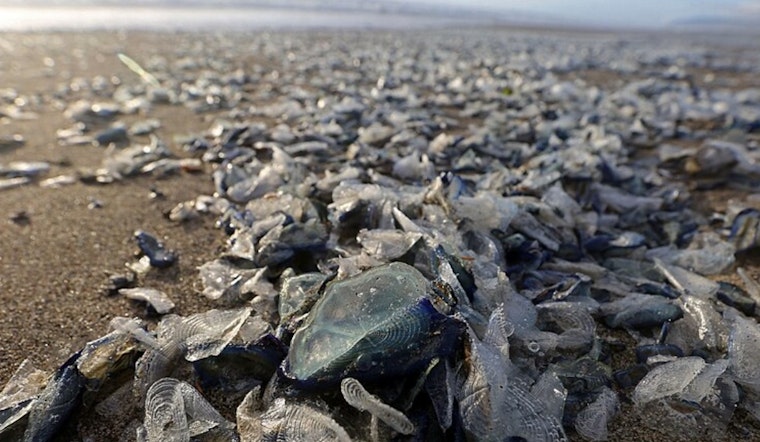
California’s coastline has turned into a surreal blue carpet this spring, as bright, electric-blue clusters of tiny, sail-topped sea creatures keep rolling ashore from the Bay Area all the way to San Diego. The visitors are Velella velella, better known as "by-the-wind sailors," and their translucent, triangular sails are leaving beaches speckled with what look like neon-blue confetti. The scene has pulled in curious walkers and sparked a rush of photos and videos from shorelines up and down the state.
San Francisco was one of the first places to get hit. Last Monday, thousands of Velella piled up on Baker Beach, Crissy Field and Ocean Beach in a kind of overnight takeover, according to the San Francisco Chronicle. Photographers and park staff described a vivid but short-lived blue blanket, with the animals drying into fragile, papery husks within days once the tide pulled back.
Farther south, the swarm has been just as intense. Local crews and beachgoers in Ventura County and around the Channel Islands have documented thick strandings at Channel Islands Harbor, Silver Strand and other nearby shores, with the blue rafts sliding in and out of the surf, as reported by CBS Los Angeles. Video from television outlets and social media shows the creatures lining up in long, dense windrows along the high-tide mark, rather than sprinkling randomly across the sand.
Why They Wash Ashore
Despite the jellyfish vibe, Velella are actually free-floating hydrozoan colonies that live at the ocean’s surface and move only by catching the breeze with a small sail. That design works beautifully in open water, but it is terrible when the wind turns toward shore. Onshore gusts shove entire flotillas into the breakers, where the waves drop them on the sand, according to the Scripps Institution of Oceanography. Because the animals cannot swim their way back out to sea, big strandings are mostly the result of wind and surface currents rather than some single hidden trigger.
Is Climate Playing a Role?
Scientists say these beach takeovers tend to be seasonal, but they can balloon in size when ocean waters run warmer and winds behave oddly. Some researchers have tied recent surges in sightings to a persistent marine heat wave and the potential influence of an El Niño pattern, according to reporting by KQED. Long-term monitoring suggests these dramatic events could become more common as ocean conditions shift, though nailing down exactly when they will occur remains a guessing game.
Even though Velella look a lot like jellyfish, their stinging cells usually are not much of a problem for people. Officials still urge folks not to poke or handle them and to keep dogs and other pets from snacking on the stranded animals, as noted by the San Francisco Chronicle. The brilliant blue hue fades quickly, typically within a few days, as the bodies dry out and are shredded by wind and waves.
For beachgoers, the spectacle is safe to admire from a respectful distance and usually vanishes on its own. Researchers say the sudden bounty briefly feeds scavengers before the remains return to the coastal ecosystem, according to the Scripps Institution of Oceanography. Anyone snapping photos is encouraged to include the date and location on public sighting platforms so scientists tracking changes along the coast can put those eye-catching images to work.




.jpg)