

























































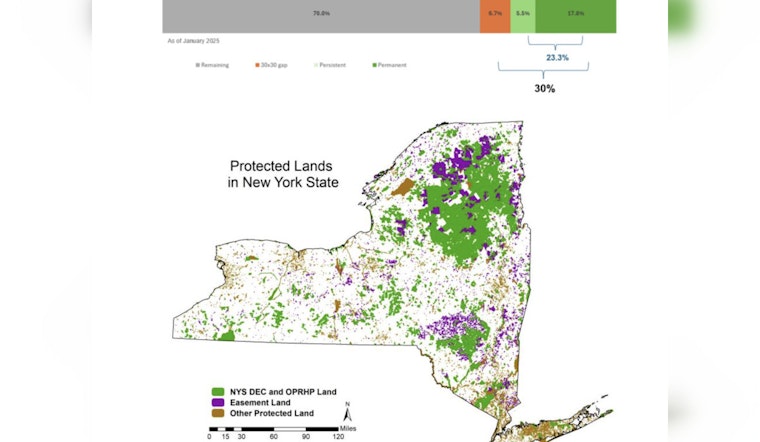
New York now has a playbook for its big conservation promise, and the clock is already ticking. State officials this week finalized a roadmap to protect 30 percent of New York's land and water by 2030, spelling out which places matter most for clean water, climate resilience and public access. The blueprint talks in terms of watersheds, working farms and timberlands, and new trails and parks. The looming question for everyone from Brooklyn renters to North Country landowners is whether the state can turn that strategy into actual acres in time.
On May 13, 2026, the Department of Environmental Conservation and the Office of Parks, Recreation and Historic Preservation published the final 30x30 Strategies and Methodology, which sets the criteria officials will use to measure and prioritize conservation, according to DEC. "The final 30x30 guidance document provides a clear, credible, and measurable path forward—one that recognizes the urgency of conservation while valuing collaboration, equity, and sound science," DEC Commissioner Amanda Lefton said in the release. The agencies say more than 23 percent of New York's lands and waters are already conserved, roughly eight million combined acres, and that more than 36,241 acres of new protections have been recorded since 2022.
The gap: acres and pace
Using the state's own figures, the remaining shortfall to reach 30 percent is roughly 2.44 million acres, a gap that would require adding more than 610,000 acres a year through 2029 to stay on schedule, according to News10 ABC. By comparison, New York's recent pace of acquisitions has been measured in the tens of thousands of acres since 2022. That math makes clear the scale of the challenge: the state would have to ramp up purchases and easement programs dramatically. Conservation advocates say that kind of acceleration, backed by faster processing of transactions, is the crucial next move.
Money and priorities
DEC also announced a new $25 million Open Space Conservation Grant Program to help land trusts, municipalities and Tribal Nations secure permanent protection for open space. The money comes from the 2022 Clean Water, Clean Air and Green Jobs bond act, according to DEC. The enacted 2025-26 state budget increased the Environmental Protection Fund to a record $425 million, which state officials say will support acquisitions, mapping and grant programs, according to the governor's office. Advocates, while welcoming the cash, warn that one-off grants and bond dollars will have to be paired with a much faster acquisition pipeline if New York is going to close the gap in less than a decade.
Trees, farms and city parks
The 30x30 framework links traditional land protection with landscape-scale tools like easements, working-land incentives and urban reforestation so that benefits reach a wide range of communities. Governor Kathy Hochul has promoted a complementary "25 Million Trees by 2033" initiative and directed new community reforestation grant rounds to support plantings and urban canopy projects, according to the governor's office. Local partners will be asked to track tree plantings and protection projects so they can be counted toward the overall 30x30 goal.
Conservation groups cautiously optimistic
Land trusts and conservation nonprofits have largely praised the plan as a solid roadmap while stressing that the hard part starts now. The Open Space Institute said the framework should help target investments where they deliver the greatest benefit, and the Land Trust Alliance noted that partnership grants and easements could protect tens of thousands more acres if funding and staffing keep up with demand. Their shared bottom line: the guidance marks a beginning, not a victory lap, and real-world implementation will decide whether New York ultimately meets its target.
Finalizing the methodology is an important milestone, but the future of New York's 30x30 effort hinges on how quickly the state can turn dollars and maps into permanent protections and on-the-ground plantings. Over the next year or so, the real test will show up in acquisition closings, easement filings and tree-planting tallies. Those numbers will determine whether the 30x30 playbook becomes a blueprint for progress or just another plan that never quite leaves the page.





