

























































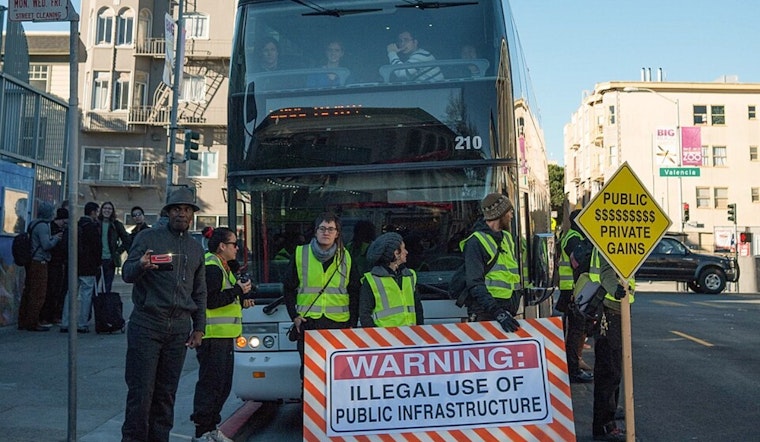
The private tech shuttles that once clogged San Francisco’s streets have quietly pulled back, leaving far calmer curbs in neighborhoods that used to be swarmed by backpacked commuters at dawn. Riders and residents say the routes feel smaller and more hit-or-miss now, a visible side effect of hybrid work schedules and fewer people making that old-school five-day trek to the office.
Data Show Shuttle Stops Plunge Citywide
Commuter-shuttle "stop events" - SFMTA’s count of pickups and drop-offs at permitted curbs - have averaged about 40% fewer per month so far this year than in 2019, according to the San Francisco Chronicle. Operators report stop events rather than exact headcounts, so the numbers track how often shuttles pull up at approved locations, even if no one gets on. That slide in stop events lines up with the broader unraveling of the rigid, five-day commute that once kept the private shuttle network humming.
Tighter Rules Shape Where Shuttles Can Go
The city lets commuter shuttles load and unload only at designated shuttle zones, and it limits larger vehicles to state-designated arterial streets, according to the SFMTA. The agency’s interactive map and shuttle program materials list current permitted stops and highlight restricted streets, which helps explain why service is clustered on big corridors instead of side streets. Local curb rules and enforcement have nudged operators to tighten up, combining routes and trimming stops rather than roaming widely.
A Few Corners Still Buzz With Pickup Traffic
Even with far fewer stops overall, a handful of corners still carry most of the action. Lombard and Scott streets in the Marina recorded the highest total pickups and drop-offs in 2024, with Geary Boulevard and the Park Presidio corridor next in line, according to the Chronicle’s analysis of SFMTA data. The paper’s charts also show that monthly stop events have settled into a new, lower plateau compared with the pre-pandemic boom. That concentration reflects where companies route buses and where tech workers still cluster in sufficient numbers to justify a curbside convoy.
Transit Agencies Claw Back Riders, Unevenly
Public transit ridership has been climbing this spring, although the comeback is lopsided. Muni, Caltrain and AC Transit were approaching roughly three-quarters of their 2019 ridership while BART still lagged at about half, according to coverage by KQED. BART’s own monthly reports show weekday ridership stuck at roughly half of its 2019 average, which is why agency leaders keep warning about looming budget holes. Those gaps mean that if commuting patterns keep shifting, riders could eventually see schedule changes or cuts unless new funding materializes.
What The New Normal Means For Commuters
SFMTA says it wants to strengthen last-mile links to regional transit by improving connections for buses, walking, biking, and rolling, and it ties that goal directly to how it manages shuttle permits and curb space, according to the agency’s shuttle program materials. For commuters, that has translated into a leaner, more concentrated shuttle network, increasingly designed to feed into fixed-route transit and micromobility rather than compete with them. The tech-bus era has not disappeared, but it now looks far smaller and more tightly focused than during the 2010s heyday.




