

























































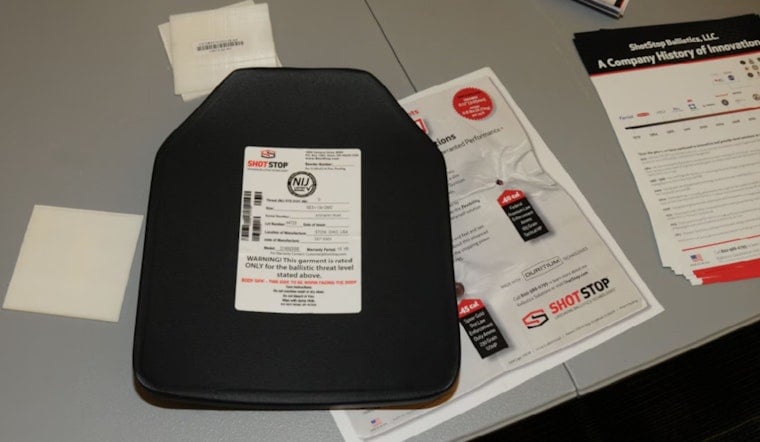
Federal and state judges this week left Stow businessman Vall Iliev and his companies on the hook for roughly $43.6 million after finding they sold counterfeit, poorly tested body-armor plates to police departments across Ohio for years. Investigators say the plates were imported from China, relabeled as "Made in Stow, Ohio" and stamped with fake National Institute of Justice (NIJ) certification marks, a deception that could have put officers at serious risk. Iliev has pleaded guilty in federal court and is serving a prison sentence for smuggling and fraud.
Judge: "Endangered public safety"
U.S. District Judge Sara Lioi wrote that Iliev's conduct "endangered public safety" and entered civil rulings that tack on steep penalties for forging NIJ labels and selling the gear, as reported by Cleveland.com. One recent order included a $1 million judgment tied to trademark infringement on the NIJ mark. Combined with prior restitution orders and settlements, the court's rulings push Iliev's total obligations to about $43.6 million.
Federal sentence and state suit
Federal prosecutors previously secured a conviction against Iliev. The U.S. Attorney's Office says he was sentenced in July 2025 to 63 months in prison and ordered to pay roughly $5.2 million in restitution, according to the U.S. Attorney's Office. On a separate track, Ohio Attorney General Dave Yost sued ShotStop Ballistics, Vallmar Studios and Iliev under the state's consumer-protection laws, and the Attorney General's office says Iliev agreed to pay about $5 million in that state action.
How the penalties add up
The NIJ's civil action and related rulings made up the largest single slice of the bill. Vallmar Studios was ordered to pay about $32.4 million in restitution and the court entered a $1 million trademark judgment against Iliev for affixing counterfeit NIJ labels, according to Cleveland.com. The NIJ sought and obtained a default judgment after alleging unauthorized use of its certification mark, as reflected in the federal docket. Justia Dockets & Filings lists the NIJ's complaint and the court's entry of default against the defendants.
Where the plates ended up
Reporting and public records indicate that more than a dozen agencies purchased armor tied to ShotStop, including local departments in Akron, Munroe Falls, Rocky River and Strongsville. Akron city leaders approved roughly $60,000 to replace SWAT plates and the department is pursuing restitution, according to reporting by WOSU. Industry and investigative reports have also identified other affected agencies and federal customers as the probe has moved forward.
Why NIJ certification matters
The National Institute of Justice serves as the Department of Justice's testing and compliance arm for body armor. Its certification program and the NIJ Compliant Products List are the primary tools agencies use to verify performance before buying, according to the NIJ. When NIJ marks are forged or misused, that independent verification disappears, and officers can end up wearing armor whose stopping power has never actually been validated. The label on the plate, in other words, does not do the job of the lab.
Legal implications
The fallout stretches across criminal, civil and bankruptcy courts. The NIJ trademark case went forward as a default action in federal court, federal prosecutors secured prison time and restitution, and ShotStop's Chapter 7 liquidation complicates efforts to make victims whole, according to court records and local reporting. Agencies and individuals who bought affected plates may have several avenues to seek compensation, including federal restitution orders, state consumer suits and claims in the bankruptcy estate, although collecting millions from a jailed defendant and a liquidated company is likely to be slow and difficult. Justia Dockets & Filings and the Ohio Attorney General's release outline the overlapping remedies.
What comes next
Departments across the region are now swapping out suspect plates and scrutinizing how they buy critical safety gear, while prosecutors and the Attorney General work to route restitution and penalty money back to victims. The case has renewed calls for agencies to lean on the NIJ's Compliant Products List and to insist on a verifiable chain of custody and proper certification paperwork when purchasing life-saving gear, as NIJ officials and the state have advised. The broader takeaway is not subtle: when lives are on the line, independent testing and proof of performance are not optional.





