

























































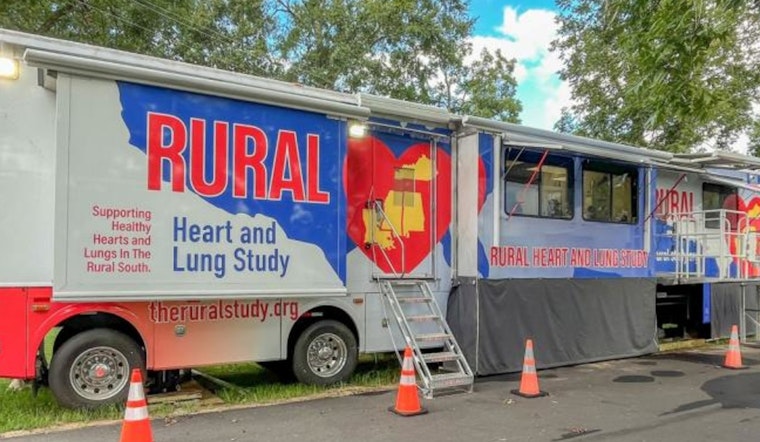
Federal health officials are betting big on UT San Antonio, handing the university a five-year, $44 million contract to expand a landmark study of health gaps in the rural South. The award will fund a mobile clinic operation that revisits participants across Alabama, Kentucky, Louisiana, and Mississippi as researchers try to unpack why rural Americans face higher rates of heart, lung, blood, and sleep disorders and shorter life expectancy.
As detailed by UT Health San Antonio, the five-year contract, which began April 22, will complete the study’s first exam cycle and support Exam 2, a re-examination of roughly 4,000 RURAL participants. "The RURAL Cohort Study takes the science to the people," Vasan S. Ramachandran, dean of the Kate Marmion School of Public Health and the study’s principal investigator, said in the announcement, framing the project as a kind of house call for entire counties.
Mobile Clinic Brings High-Tech Scans To County Doorsteps
The project relies on a custom mobile examination unit outfitted with a CT scanner, pulmonary-function testing, laboratory space, and AI-guided cardiac ultrasound. The National Heart, Lung, and Blood Institute describes the vehicle as a high-tech clinic on wheels that has already visited several counties and tested thousands of residents, according to NHLBI. The on-site approach is designed to cut through distance and infrastructure barriers that often make traditional clinic-based research a nonstarter in the rural South.
What Researchers Will Measure And How Communities Could Gain
Researchers will gather cardiovascular and lung screenings, blood and genetic tests, sleep and activity monitoring, and detailed surveys on social determinants of health. So far, the study has enrolled about 4,600 residents across 10 rural counties. Study leaders say findings will be shared with participants and community officials and that results and resources will be invested back into the participating counties to steer prevention and care efforts, according to the San Antonio Express-News.
Why The Rural South Is In The Spotlight
Public-health researchers point to long-standing drivers including food insecurity, limited access to care, higher smoking rates, and economic disinvestment that have produced disproportionate heart and lung disease burdens and shorter lifespans in parts of the rural South. The National Heart, Lung, and Blood Institute has also outlined plans for a second exam cycle and invited investigator-led ancillary projects, noting a targeted Jan-Feb 2027 window for the next round of testing and a roughly 4,000-participant re-examination plan, per an NHLBI notice.
UT San Antonio will helm a collaborative team that includes 16 institutions nationwide, and university officials say the award highlights San Antonio’s growing role in population-health research and community-engaged science. Community groups, local health departments, and investigators will be watching the Exam 2 rollout and any chances to plug ancillary projects into the mobile-exam platform, according to UT Health San Antonio.





