

























































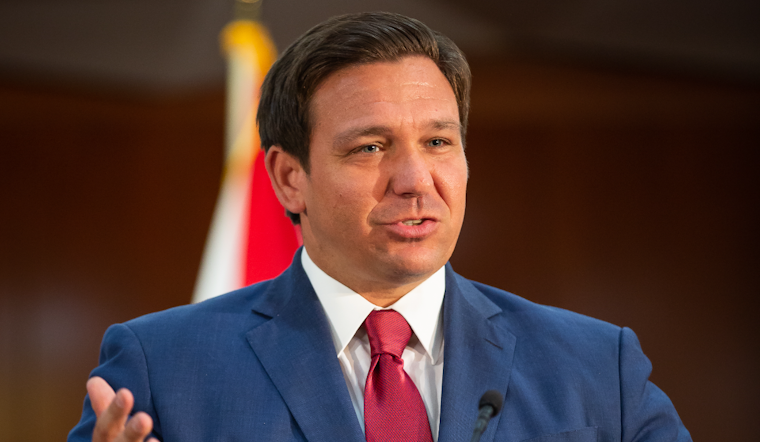
Governor Ron DeSantis and the Florida Cabinet on Tuesday signed off on more than $87 million in state reimbursements to 56 local law enforcement agencies through the Local Law Enforcement Immigration Grant Program. The shopping list runs from mobile radios and AI-enabled camera systems to more routine gear such as taser bundles, body armor plates, vehicle ballistic panels, and a handful of e-bikes, all funded out of a $250 million pot lawmakers set aside last year to support local cooperation with federal immigration enforcement.
Sitting as the State Board of Immigration Enforcement, the governor and Cabinet moved a thick stack of applications through the process in a single meeting. According to Orlando Weekly, most of Tuesday’s approvals focused on radios and AI-driven policing systems rather than headline-grabbing extras.
What the board approved
The Florida Department of Law Enforcement’s June 9 cabinet package shows the Brevard County Sheriff’s Office as the single largest recipient, with just over $14.2 million in approved reimbursement requests. That includes about $7 million for AI-driven in-car cameras, roughly $3 million for radio upgrades, and $1.3 million for a Peregrine platform subscription. Those application packets and itemized budgets are contained in the FDLE cabinet package, which lays out each agency’s requested line items and proposed spending.
FDLE documents show many agencies asking for hardware and software that would centralize dispatch, license plate readers, and video evidence, while others stuck to more traditional kits such as radios and inmate processing equipment. The cabinet package serves as the main record of the line-by-line awards and reflects how the board evaluated the individual applications.
Tech and radios dominate the requests
Mobile and portable radios alone account for more than $30.1 million of the approvals, and two policing vendors emerge as especially big winners. Axon is set to receive roughly $15.4 million, and Peregrine-related contracts total about $14.6 million. That breakdown of vendors and categories was detailed in coverage of the meeting by Orlando Weekly.
Small buys, big optics
The FDLE application packets also list a long tail of lower-dollar requests that still say a lot about how agencies plan to use the money. Bay County sought $300,000 for 120 Taser bundles. Auburndale Police asked for $40,000 for 50 body armor plates. Franklin County requested $35,000 for vehicle ballistic panels, and St. Lucie County asked for $19,000 for e-bikes. The records also show modest purchases, such as Hamilton County’s $3,000 request for electric spotlights and Columbia County’s $2,800 for suicide prevention mattresses.
How the program is supposed to work
The Local Law Enforcement Immigration Grant Program was created by the Legislature and backed with a $250 million appropriation. The Senate analysis and bill text spell out what qualifies as an eligible expense, the reporting rules, and the caps on reimbursements. Under the statute and appropriation, grants can be used for training, detention bed reimbursements, transportation, equipment, and even modest bonuses, and participating agencies must report encounter data and other metrics back to state authorities.
Privacy and civil liberties concerns
Civil rights and privacy groups have warned that tying large sums of state money to AI platforms, centralized evidence systems, and broader surveillance capacity could quietly expand police monitoring without sufficient safeguards. Organizations, including Upturn, have urged vendors and agencies not to integrate real-time biometric tools with body-worn cameras, and recent pilots of AI-enabled camera features overseas have drawn renewed scrutiny from advocates and researchers. For background on those warnings, see work from Upturn and reporting on overseas tests of AI body cam features in outlets such as WCAX.
Local law enforcement leaders say the grant money helps cover costly equipment and improves coordination with federal partners. Privacy advocates counter that the size and speed of the awards call for far more public scrutiny. With the board’s approval in hand, the process now shifts from application to reimbursement, and agencies can start seeking payments through FDLE as they submit documentation tied to eligible immigration enforcement activities.




